Under Sink Reverse Osmosis Systems: A Plain Buyer's Guide
An under sink reverse osmosis system is a good fit when you want a separate drinking-water tap and a membrane that reduces TDS. Choose a tank model for stored water without under-sink power, or a tankless model if cabinet space and an outlet suit your setup.
On this page (10 sections)
- What does an under sink reverse osmosis system do?
- Who should consider under-sink reverse osmosis?
- How do tank and tankless systems differ?
- What should you measure before buying?
- What certifications and reduction claims matter?
- How much maintenance does an RO system need?
- Does reverse osmosis waste water?
- When is a non-RO under-sink filter a better fit?
- How much does an under sink reverse osmosis system cost to own?
- Which under sink reverse osmosis system should you choose?
An under sink reverse osmosis system gives you a separate faucet for water filtered through a membrane, often with carbon stages before or after it. It can reduce total dissolved solids, but it also needs cabinet space, a drain connection and regular filter changes.
The right setup depends on what you want to change in your water and what your sink cabinet can fit. A tank system stores filtered water and usually works without power; a tankless system frees tank space but may need an outlet.
If you want a direct comparison of those layouts, see tank vs tankless reverse osmosis systems. This guide covers how the systems work, what to check before buying, and when a simpler under-sink filter may be enough.
What does an under sink reverse osmosis system do?
An under sink reverse osmosis system uses water pressure to push water through a semipermeable membrane. The membrane reduces dissolved material, including TDS, while other stages commonly handle sediment, chlorine, taste or odor.
A typical system connects to the cold-water supply and routes filtered water to a dedicated faucet. The membrane rejects some of the incoming water to a drain, and a tank model stores filtered water for use.
RO is useful when you want to reduce dissolved substances that a basic carbon filter may leave behind. But “more stages” does not automatically mean a better fit; compare the system's certifications and specific reduction claims with the issues you want to address.
If taste is your main concern and TDS reduction is not a goal, a carbon or other non-RO filter could be a simpler fit. Our guide to under-sink water filters that skip reverse osmosis explains that alternative.
Who should consider under-sink reverse osmosis?
Consider an under-sink RO system if you want a dedicated drinking-water faucet and TDS reduction, and you have room for its parts and connections. It may suit a household that fills drinking bottles, cooks with filtered water or connects the outlet to a compatible refrigerator.
An RO system may be unnecessary if your main goal is improving chlorine taste. A non-RO filter can take less space and avoid the system's drain connection, though its contaminant reductions differ.
Start with your water report or a suitable water test. Match the contaminants you care about to independently supported reduction claims for the complete system, not just a component or a general claim about RO.
For homes using well water, first check the well's test results and consider whether the water needs treatment before it reaches the kitchen. See under-sink water filters for well water for factors to consider.
How do tank and tankless systems differ?
A tank model stores filtered water in a pressure tank, while a tankless model filters water on demand. Choose based on available cabinet space, power access and how you use water.
| Feature | Tank system | Tankless system |
|---|---|---|
| Under-sink layout | Needs room for a storage tank | No storage tank |
| Electricity | Some models work without it | Many models require an outlet |
| Water supply | Draws from stored filtered water | Filters as water is requested |
| Checks before buying | Measure system and tank space | Measure system space and locate an outlet |
| Useful comparison | Best tank RO systems | Best tankless RO systems |
Tank systems can suit a cabinet without an outlet, but the tank takes up space. Tankless systems can leave more room for storage, though the unit and its power connection still need to fit.
Don't rely on the word “compact.” Measure the cabinet's width, height and depth, and account for pipes, shutoff valves, disposal units, cleaning supplies and room to change filters.
What should you check in a tank system?
A tank system can be a practical choice when you want stored filtered water and don't have under-sink power. Check the tank's dimensions alongside the filtration unit, since the tank may be the part that crowds the cabinet.
Look for the system's stated membrane capacity, included tank and faucet, and certifications for the complete system. Capacity figures describe production under specified conditions; actual output can depend on water pressure and temperature.
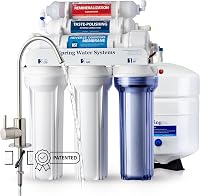
The iSpring RCC7AK-BN is a tank-style system with a storage tank and brushed-nickel faucet. Its six-stage setup includes a mineral stage, and iSpring says the complete system is certified to NSF/ANSI 58.
The APEC ROES-50 is another tank option, with a five-stage system, tank, faucet and installation kit. APEC recommends replacing its filters every 6 to 24 months based on incoming water quality.
For a closer product comparison, read iSpring RCC7AK vs APEC ROES-50.
What should you check in a tankless system?
A tankless system can be useful when you want to preserve under-sink storage space. Confirm that the unit fits and that an outlet is available, then check its stated drain ratio and filter replacement process.
The Waterdrop G3P600 is a tankless system that needs under-sink electricity. Waterdrop states that it produces up to 600 gallons per day, has a 2:1 pure-to-drain ratio, and includes a faucet with a TDS monitor and filter-life tracker.
Its stated cabinet dimensions are 18.12 in long, 5.67 in wide and 17.72 in high. Measure around plumbing and other obstructions, and check the faucet and drain connection requirements before choosing it.
See our Waterdrop G3P600 review for a closer look, or compare tankless models in the G3P800 vs X8 guide.
What should you measure before buying?
Measure the entire cabinet and identify where each system part will go. A fit depends on the unit, tank, faucet tubing, drain line and access for maintenance, not just the main filter housing.
Before you order, check:
- Cabinet width, height and depth, including the space taken by pipes and the garbage disposal.
- The tank dimensions if the system has one.
- An outlet location if the system requires electricity.
- The route for feed water, filtered water and the drain connection.
- Whether your sink or countertop has a suitable faucet hole.
- Room to reach filters and remove them for replacement.
- The faucet finish and the number of sink holes already in use.
Some systems include a dedicated faucet, while others may need a compatible opening drilled into the sink or counter. Confirm the material and installation requirements before drilling; a plumber can help if you are unsure.
A refrigerator connection may also be possible with some systems, but compatibility and extra parts vary. Check the specific system's instructions if you want filtered water for an ice maker or refrigerator dispenser.
What certifications and reduction claims matter?
Check certifications for the specific system and the reduction claim you care about. A certification for materials or one contaminant does not prove the system reduces every substance you may want removed.
NSF/ANSI 58 covers reverse osmosis drinking-water treatment systems. NSF/ANSI 42 addresses aesthetic effects such as chlorine taste and odor, while NSF/ANSI 372 relates to lead content in drinking-water system components.
Read the certification scope and confirm the model number in the certifier's directory. For independent guidance, see the NSF drinking water treatment standards and the EPA's guide to home drinking water treatment.
Pay attention to the difference between a full-system certification and a claim about an individual filter or material. If a contaminant is your main concern, use the exact certified reduction claim as your comparison point.
How much maintenance does an RO system need?
An RO system needs filter changes on a schedule that depends on the model and your incoming water. Check the maker's filter schedule and budget time for each stage, including the membrane.
Sediment and carbon prefilters protect the membrane and typically need replacement more often than the membrane itself. A post-filter may also have its own interval, so don't treat the whole system as one cartridge with one lifespan.
The iSpring RCC7AK-BN lists separate replacement sets for six months, one year, two years and three years. APEC recommends filter changes every 6 to 24 months based on incoming water quality for the ROES-50.
Use taste, flow changes or filter indicators as prompts to check the system, not as a replacement for the stated schedule. Our guides explain how often to change RO filters and when to replace an RO membrane.
If water flow slows, the cause may be a clogged filter, low feed pressure or a tank issue. See why RO water pressure can be low and what to check when an RO tank is not filling.
Does reverse osmosis waste water?
Yes, an RO system sends some water to the drain as it separates dissolved material from filtered water. Compare the stated pure-to-drain ratio if water use is a key concern.
That ratio is a system claim and can vary with operating conditions. Tankless systems may publish a ratio, while tank systems may describe water use differently; check the exact model details rather than assuming all RO units behave alike.
A drain line is part of the installation, so confirm that your sink plumbing can accept it. Read why reverse osmosis systems waste water for more on the trade-off and what can affect it.
When is a non-RO under-sink filter a better fit?
A non-RO filter may be a better fit if your main goal is reducing chlorine taste or certain other listed contaminants, and you don't need TDS reduction. It can avoid a storage tank and RO drain line, depending on the design.
The CuZn UC-200 is an inline under-sink filter that connects to a kitchen or bathroom sink. CuZn says it uses sediment, KDF-55 and coconut-shell carbon, and notes that it does not reduce TDS.
It is a different type of filter from the three RO systems above, so don't compare it as an RO substitute if dissolved-solids reduction is your goal. Its stated filter life is up to five years or 50,000 gallons, depending on incoming water quality.
For a fuller comparison of non-RO options, see whether under-sink water filters are worth it.
How much does an under sink reverse osmosis system cost to own?
Ownership cost includes replacement filters, installation parts or labor, and water sent to the drain. Compare ongoing filter costs and replacement intervals, not just the amount due at checkout.
Filter schedules differ by system and water quality. Some replacement sets combine several stages, while others require separate cartridges at different intervals.
If you plan to install the system yourself, check whether the kit includes the faucet, tank and fittings you need. If you hire a plumber or need countertop work, include that cost in your comparison.
Read how much a reverse osmosis system costs to own for a breakdown of the expenses to consider.
Which under sink reverse osmosis system should you choose?
Choose a tank system if you want stored filtered water and don't have an outlet under the sink; choose a tankless system if cabinet space is tight and power is available. Choose a non-RO filter if TDS reduction isn't part of your goal.
Start with your water report, then confirm certifications and reduction claims for the contaminants that matter to you. Measure the cabinet and check the faucet, drain, power and filter-access requirements before you decide.
For a tank setup, compare the best under-sink reverse osmosis systems with a tank. If you prefer a tankless layout, start with tankless reverse osmosis systems for tight cabinets.
Frequently asked questions
What does an under sink reverse osmosis system remove?
An under sink reverse osmosis system pushes water through a membrane and can reduce total dissolved solids, or TDS. Reduction varies by system and water conditions, so check a system's specific certification and contaminant claims, then compare them with your local water report.
A carbon filter may improve taste without reducing TDS.
Do under sink reverse osmosis systems need electricity?
Some under sink reverse osmosis systems work without electricity, while many tankless models need an outlet to run. Check the exact system requirements and measure the distance to a suitable outlet before buying.
Tank models also need room for the storage tank and the drain and water connections.
Is a tank or tankless reverse osmosis system better?
A tank system stores filtered water and can work without under-sink power, but its tank takes cabinet space. A tankless system can free that space and may deliver water quickly, but it often needs electricity.
Compare your cabinet, outlet, water use and filter costs before choosing.
Does reverse osmosis waste water?
Reverse osmosis sends some incoming water to the drain while producing filtered water, so the amount depends on the system and operating conditions. Compare the stated pure-to-drain ratio when water use matters to you, and read our guide to why reverse osmosis systems waste water for ways to understand the trade-off.
Can I install an under sink reverse osmosis system myself?
Some systems include quick-connect fittings, tubing and installation instructions, but the work can involve a faucet opening, water-supply connection and drain-line connection. Check your sink and cabinet before buying, and use a plumber if drilling, shutoff valves or plumbing changes are outside your comfort level.