iSpring RCC7AK vs APEC ROES-50: Two Tank RO Favorites (October 2026)
Choose the iSpring RCC7AK-BN for a built-in mineral stage and top-mounted faucet fastener; choose the APEC ROES-50 for a simpler 5-stage system rated at 50 gallons per day. Both are under-sink tank systems, so cabinet space and filter preferences can settle the choice.
On this page (9 sections)
- iSpring RCC7AK vs APEC ROES-50: which should you choose?
- How do their capacity and stage counts compare?
- Which system adds minerals?
- What installation features differ?
- How should you compare filtration claims?
- What does filter replacement involve?
- Which one makes sense for your kitchen?
- What is the verdict on iSpring RCC7AK vs APEC ROES-50?
- Frequently asked questions
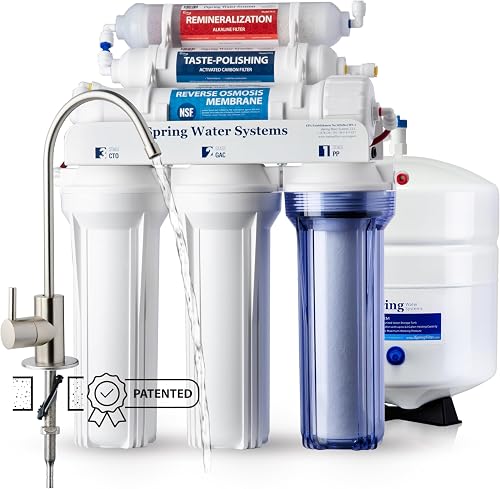
Choose the iSpring RCC7AK-BN for its 75 GPD rating, AK mineral stage, and top-mounted faucet fastener; choose the APEC ROES-50 for a 5-stage system rated at 50 GPD. In this iSpring RCC7AK vs APEC ROES-50 comparison, the practical differences are capacity, mineral treatment, and installation details.
Both are under-sink reverse osmosis systems with storage tanks. The iSpring has 6 stages and a transparent first-stage housing, while the APEC ROES-50 has 5 stages and includes quick connection fittings and colored tubing.
There’s also a third option for shoppers who want APEC with a mineral stage: the ROES-PH75 is rated at 75 GPD and includes a calcium mineral cartridge.

iSpring RCC7AK vs APEC ROES-50: which should you choose?
Pick the iSpring if its mineral stage and higher stated capacity fit your needs; pick the ROES-50 if you want a 5-stage setup rated at 50 GPD. Neither difference alone tells you how much water your household will use or which taste you’ll prefer.
The iSpring’s AK stage is designed to add minerals and provide a balanced pH. APEC’s ROES-50 doesn’t specify a mineral stage, so it suits buyers who want its listed 5-stage arrangement without choosing based on remineralization.
Both use a separate faucet and storage tank. Before choosing, check the space under your sink and consider how often you’ll use the faucet, how many people share it, and whether the water will also feed an ice maker.
For a broader look at tank systems and other options, see our guide to under-sink reverse osmosis systems.
How do their capacity and stage counts compare?
The iSpring and APEC ROES-PH75 are rated at 75 gallons per day, while the ROES-50 is rated at 50. These are stated system capacities, not a promise about how much water you’ll draw from the faucet in a day.
The iSpring RCC7AK-BN and ROES-PH75 each use 6 stages. The ROES-50 uses 5 stages.
A higher stage count doesn’t by itself tell you which system is a better fit; the kind of treatment and your preferences matter too.
The ROES-50 is the smallest capacity of the three by its stated GPD rating. That may be enough for a household with modest demand, while a larger household might prefer to compare the two 75 GPD models.
Daily output also depends on conditions. APEC gives the ROES-50 an operating pressure range of 40–85 psi, and the iSpring lists 70 psi.
Check the installation instructions for the exact requirements in your home.
Which system adds minerals?
The iSpring RCC7AK-BN and APEC ROES-PH75 include mineral stages; the ROES-50 does not specify one. Choose a mineral model if you prefer that feature, and compare the details of the stage rather than assuming all remineralization filters work alike.
iSpring describes its AK stage as a natural mineral stage intended to add minerals and balance pH. The ROES-PH75 uses a calcium mineral cartridge for pH enhancement and added calcium minerals.
The ROES-50 may make more sense if you don’t want to select a system for a mineral stage. If you’re unsure whether you’ll enjoy mineralized water, think about your taste preference and whether you want that feature before choosing.
The iSpring RCC7AK review takes a closer look at the iSpring’s 6-stage design. For a different format entirely, compare tank and tankless reverse osmosis systems.
What installation features differ?
The iSpring has a top-mounted fastener for faucet installation, while the ROES-50 includes quick connection fittings and colored tubing. These details can help you decide which installation steps suit your sink and comfort level.
iSpring says its patented top-mounted fastener lets you install the faucet from above the counter. It also describes a DIY-friendly setup with push-to-connect fittings, color-coded tubing, a manual, and step-by-step videos.
APEC’s ROES-50 also uses quick connection fittings and colored tubing. Its included components include a faucet, tank, filter set, installation kit, and instructions.
Both systems still require room to work under the sink. Check whether your cabinet has space for the filters, tank, drain connection, and tubing, with enough access for future changes.
If you plan to install the system yourself, read the under-sink RO installation guide before you begin.
The product details describe the iSpring as operating without electricity. For the APEC ROES-50, check the current manual for power requirements and installation instructions before you plan around its power-source field.
How should you compare filtration claims?
Compare the specific certification and reduction claims for each model, and check which contaminants matter for your water. Broad phrases such as “1000+ impurities” don’t tell you how a system performs against every contaminant.
iSpring identifies the RCC7AK as NSF/ANSI 58 certified as a complete system. Its listed reduction figures cover several contaminants, including TDS, PFAS, chlorine, fluoride, and lead.
APEC describes the ROES-50 as a 5-stage system that removes impurities including arsenic, chlorine, lead, fluoride, and heavy metals. The system’s item highlights include NSF certifications 372 and 58.
APEC says the ROES-PH75 is WQA certified and describes reduction of contaminants including chlorine, fluoride, arsenic, and lead. Certification and reduction information can help narrow a choice, but it doesn’t replace checking your own water or reading the exact system documentation.
If a specific contaminant is your main concern, look for a claim that names it and applies to the exact model. For local water information, you can also review your supplier’s annual report or get a suitable water test.
What does filter replacement involve?
Choose a system whose replacement schedule and filter access you can keep up with. A filter change is easier to plan when you know which parts need attention and where they sit in the cabinet.
The iSpring lists a 6-month filter life cycle and replacement sets for 6-month, 1-year, 2-year, and 3-year intervals. Its transparent first-stage housing lets you see sediment buildup, which can help you monitor that prefilter.
APEC recommends changing ROES-50 filters every 6–24 months based on incoming water quality. Follow the instructions for your system and water conditions, since one schedule may not fit every home.
The ROES-PH75 details here don’t give a full replacement schedule. Check the system’s instructions and replacement filter guidance before you buy if ongoing filter availability or timing is a key concern.
Our guide to how often to change reverse osmosis filters explains the usual factors that affect timing. For a specific low-flow problem, see why RO water pressure can be low.
Which one makes sense for your kitchen?
Choose by capacity, mineral preference, and the installation feature you’ll value most. All three are tank systems, so cabinet space remains part of the decision.
The iSpring RCC7AK-BN is the clearest fit if you want its 75 GPD rating, AK mineral stage, visible first-stage housing, and faucet fastener that installs from above. Its listed dimensions are 15.5 x 16 x 18 inches.
The APEC ROES-50 is a straightforward match if you want a 5-stage tank system rated at 50 GPD with quick connections and colored tubing. Its listed dimensions are 15.5 x 5.25 x 17 inches.
The APEC ROES-PH75 is worth comparing if you want APEC, 75 GPD, and a calcium mineral cartridge in a 6-stage system. Its listed dimensions are 15.5 x 5.25 x 17.5 inches.
Dimensions alone don’t account for the tank, hoses, fittings, or room needed to change filters. Measure your cabinet and check the manuals before ordering.
What is the verdict on iSpring RCC7AK vs APEC ROES-50?
Choose the iSpring RCC7AK-BN for its 75 GPD rating, mineral stage, and top-mounted faucet fastener; choose the APEC ROES-50 for its 5-stage layout and 50 GPD rating. If you want APEC with higher stated capacity and added calcium minerals, compare the ROES-PH75.
To choose among tank systems beyond these models, browse our under-sink RO system guide. Match the system to your cabinet, household demand, and preferred water taste before you focus on stage count alone.
The score weighs specs, features, and buyer feedback against what you’re shopping for.
Frequently asked questions
Is the iSpring RCC7AK better than the APEC ROES-50?
The iSpring RCC7AK-BN has a higher stated capacity, 75 gallons per day versus 50, and includes an AK mineral stage. The APEC ROES-50 uses 5 stages and has quick connections and colored tubing.
Choose based on capacity, mineral preference, and the installation details that matter in your kitchen.
Does the APEC ROES-50 add minerals?
The ROES-50 details here describe a 5-stage reverse osmosis system and don’t specify a mineral stage. If you want an APEC tank system with added calcium minerals, compare the ROES-PH75, which has a calcium mineral cartridge and a 75 GPD rating.
Do these reverse osmosis systems need electricity?
The iSpring description says the RCC7AK-BN works without electricity. The ROES-50 details include a power-source field but don’t clarify how it applies to normal operation, so check the current manual for its requirements before planning installation.
How much space do these systems need?
Both systems install under the sink and include a storage tank, so measure the cabinet for the system, tank, tubing, and access for filter changes. The listed system dimensions don’t describe the full space needed for every connection, and the tank has its own footprint.
How often do the filters need replacing?
The iSpring lists a 6-month filter life cycle and offers replacement sets for different intervals. APEC recommends replacing ROES-50 filters every 6–24 months based on incoming water quality.
Follow the instructions for your exact system and water conditions.
Frequently asked questions
Is the iSpring RCC7AK better than the APEC ROES-50?
The iSpring RCC7AK-BN has a higher stated capacity, 75 gallons per day versus 50, and includes an AK mineral stage. The APEC ROES-50 uses 5 stages and has quick connections and colored tubing.
Choose based on capacity, mineral preference, and the installation details that matter in your kitchen.
Does the APEC ROES-50 add minerals?
The ROES-50 details here describe a 5-stage reverse osmosis system and don't specify a mineral stage. If you want an APEC tank system with added calcium minerals, compare the ROES-PH75, which has a calcium mineral cartridge and a 75 GPD rating.
Do these reverse osmosis systems need electricity?
The iSpring description says the RCC7AK-BN works without electricity. The ROES-50 details include a power-source field but don't clarify how it applies to normal operation, so check the current manual for its requirements before planning installation.
How much space do these systems need?
Both systems install under the sink and include a storage tank, so measure the cabinet for the system, tank, tubing, and access for filter changes. The listed system dimensions don't describe the full space needed for every connection, and the tank has its own footprint.
How often do the filters need replacing?
The iSpring lists a 6-month filter life cycle and offers replacement sets for different intervals. APEC recommends replacing ROES-50 filters every 6–24 months based on incoming water quality.
Follow the instructions for your exact system and water conditions.