iSpring RCC7AK Review: Six-Stage Tank RO (October 2026)
The iSpring RCC7AK-BN suits kitchens that want a tank-based RO system with an alkaline mineral stage. Its 75 GPD capacity, top-mounted faucet fastener and clear first-stage housing are useful details to weigh against cabinet space and filter upkeep.
On this page (8 sections)
- The iSpring RCC7AK review at a glance
- What does the six-stage system include?
- How much cabinet space does the RCC7AK need?
- What should you know about installation?
- What does the alkaline mineral stage do?
- How does the iSpring compare with other systems?
- What maintenance does the RCC7AK require?
- Is the iSpring RCC7AK the right choice?
The iSpring RCC7AK-BN is a tank-based reverse osmosis system with six filtration stages and an alkaline mineral stage. Its 75 GPD capacity, top-mounted faucet fastener and clear first-stage housing give it a useful mix of filtration and installation features for an under-sink setup.
The main trade-off is space: this system needs room for a storage tank as well as the filter assembly. If you want tankless storage or a simpler five-stage setup, the alternatives below may fit better.
The iSpring RCC7AK review at a glance
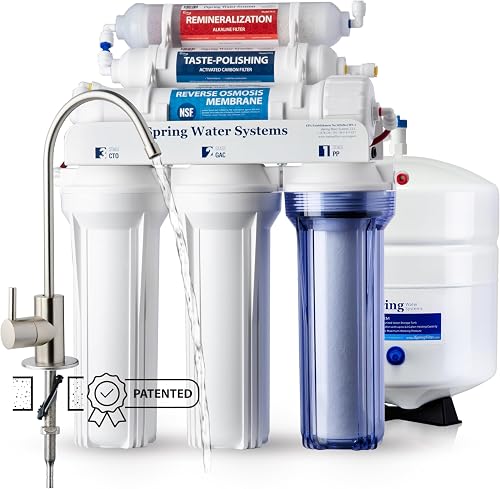
The RCC7AK-BN stands out for its alkaline mineral stage and top-mounted faucet fastener. The transparent first-stage housing also lets you see sediment buildup, a practical reminder to check the prefilter during routine care.
iSpring RCC7AK-BN: Best for alkaline remineralization
- 75 GPD
- Six-stage filtration
- Alkaline mineral stage
- Top-mounted faucet fastener
A tank RO system with a mineral stage and a faucet designed for installation from above the counter. The clear first-stage housing makes sediment buildup visible.
Pros
- 75 GPD capacity
- Alkaline mineral stage
- Top-mounted faucet fastener
- Clear first-stage housing
Cons
- Needs room for a storage tank
- Multiple stages mean several filters to maintain
iSpring describes the system as NSF/ANSI 58 certified and states that it reduces TDS and a range of other contaminants. Check the certification details and performance claims against your water concerns before choosing any filtration system.
Who should consider the iSpring RCC7AK?
Consider it if you want a conventional tank RO layout, alkaline remineralization and a stated capacity of 75 GPD. The fastener design may also help when the faucet mounting nut would be difficult to reach from below the counter.
It may be a poor fit if your cabinet is already crowded or you prefer a system without a tank. Measure the cabinet and account for access to the filters, shutoff valve and tank before you decide.
What does the six-stage system include?
The RCC7AK uses six filtration stages, including a reverse osmosis membrane and an alkaline mineral stage. The system is designed to filter water and then add minerals in its final stage.
The first-stage housing is transparent, so you can visually check for sediment buildup. That view can help you remember to inspect the filter, though it doesn't replace following the manufacturer's replacement guidance.
The product is rated for 75 gallons per day. That is a capacity figure, not a promise that your household will draw water at that rate under every plumbing condition.
iSpring also highlights quick-fitting connections and color-coordinated tubing. These details can make the connections easier to follow during installation, but you should still read the manual and confirm that your plumbing and sink are compatible.
How much cabinet space does the RCC7AK need?
The RCC7AK needs space for both the filter assembly and its storage tank. Its listed dimensions for the system are 15.5 in long, 16 in wide and 18 in high, so check how those measurements align with your cabinet.
Measure around the sink bowl, garbage disposal, water lines and cleaning supplies. Leave access to the filter housings so you can change cartridges without taking apart other cabinet storage.
Also check the counter and sink for the faucet opening. The top-mounted fastener is designed to let you tighten the faucet from above, but it still needs a suitable opening and enough clearance around the faucet base.
The included components are a reverse osmosis system, brushed nickel faucet, storage tank and extra tool set. Confirm that the included connections match your kitchen before beginning work.
Our under-sink reverse osmosis system guide explains how tank systems fit into a kitchen setup and what to measure before buying.
What should you know about installation?
The RCC7AK is described as DIY-friendly, with quick-fitting connections, color-coordinated tubing and a top-mounted faucet fastener. Those features can simplify parts of installation, but the job still involves connecting to a water supply and drain.
Before you start, compare your existing supply fitting with the system's convertible water adapter, which is described as compatible with 1/2 in NPT and 3/8 in compression fittings. Check the manual for any other connection requirements and confirm you have the right tools.
The faucet design addresses a familiar under-sink task: tightening a mounting nut in a cramped space. Its fastener is intended to be installed entirely from above the counter.
If you're weighing the work against a professional installation, read our step-by-step under-sink RO installation guide. It covers planning the faucet, feed line and drain connections.
What does the alkaline mineral stage do?
The alkaline stage is intended to add minerals after reverse osmosis filtration. iSpring describes it as delivering water with a balanced pH and multiple minerals; those are brand claims, so consider whether remineralization is a feature you specifically want.
The APEC ROES-PH75 also has a mineral stage, with calcium identified as its mineral media. By contrast, the APEC ROES-50 is a five-stage system without a stated alkaline stage.
If a mineral stage is not important to you, compare the RCC7AK with the APEC ROES-50 to see how their filtration stages and system layouts differ. That comparison can help you decide whether the iSpring's additional stage and faucet design matter for your kitchen.
How does the iSpring compare with other systems?
The iSpring is a tank system with 75 GPD capacity and an alkaline stage, while the Waterdrop G5P500A is tankless and has a stated 500 GPD capacity. Those figures describe different system designs and should be compared alongside space, power and installation needs.
| System | Design | Stated capacity | Mineral stage |
|---|---|---|---|
| iSpring RCC7AK-BN | Tank | 75 GPD | Alkaline mineral stage |
| APEC ROES-50 | Tank | 50 GPD | No alkaline stage stated |
| Waterdrop G5P500A | Tankless, corded electric | 500 GPD | Alkaline mineralization |
| APEC ROES-PH75 | Tank | 75 GPD | Calcium mineral stage |
APEC ROES-50: Best for a simpler five-stage setup

- 50 GPD
- Five-stage filtration
- Tank included
- Quick connection fittings
A conventional tank RO option with five filtration stages and quick connection fittings. Consider it if you want fewer stages and don't need the RCC7AK's alkaline mineral stage.
Pros
- Five-stage filtration
- Tank and brushed nickel faucet included
- Quick connection fittings
Cons
- Lower stated daily capacity than the iSpring
- No alkaline mineral stage
The APEC ROES-50 is the simpler alternative if you want a five-stage tank system and don't need alkaline remineralization. It includes a tank, brushed nickel faucet, filter set and installation kit.
Waterdrop G5P500A: Best for tankless cabinet space

- Tankless design
- 500 GPD
- Alkaline mineralization
- 2:1 pure-to-drain ratio
A tankless alternative with alkaline mineralization and a stated 500 GPD capacity. It needs an electrical connection and uses a different cabinet layout from the RCC7AK.
Pros
- Tankless design
- Alkaline mineralization
- Stated 500 GPD capacity
Cons
- Requires electricity
- Faucet installation requires drilling a countertop hole
The Waterdrop G5P500A uses a tankless layout, which may be a better match when cabinet space is limited. It requires electricity, and faucet installation requires drilling a countertop hole.
APEC ROES-PH75: Best for a 75 GPD alkaline alternative

- 75 GPD
- Six-stage filtration
- Calcium mineral stage
- Tank included
A 75 GPD tank system with six stages and a calcium mineral stage. Compare its stated features with the iSpring if you want alkaline remineralization from another brand.
Pros
- 75 GPD capacity
- Six-stage filtration
- Calcium mineral stage
Cons
- Needs room for a storage tank
- No top-mounted faucet fastener noted
The APEC ROES-PH75 keeps the tank format and 75 GPD capacity while using a calcium mineral stage. Compare the cabinet dimensions, installation parts and filter schedule for the system you are considering.
What maintenance does the RCC7AK require?
The RCC7AK needs regular filter checks and replacements to keep its stages maintained. Its product details give a six-month filter life cycle and name replacement sets for six months, one year, two years and three years.
Use the manual's schedule for your water conditions and system configuration. Don't assume every stage uses the same cartridge or replacement interval.
The clear first-stage housing can help you inspect sediment buildup between scheduled changes. Keep a note of installation and replacement dates so you can track each stage without relying on memory.
For a broader schedule, see how often to change reverse osmosis filters. If tank output changes, our guide to checking RO tank pressure can help you investigate one part of the system.
Is the iSpring RCC7AK the right choice?
Choose the RCC7AK-BN if you want a 75 GPD tank system, alkaline mineral stage and faucet designed for top-side installation. Its visible first-stage housing is another practical feature for someone who wants to keep an eye on sediment buildup.
Choose the APEC ROES-50 if a five-stage system without a stated mineral stage better matches your needs. Consider the Waterdrop G5P500A if you prefer a tankless design and can accommodate its electrical and faucet installation requirements.
Before buying, measure your cabinet and faucet opening, then check the filter schedule and replacement set that fits your maintenance plan. For other tank options, compare our best under-sink reverse osmosis systems with a tank.
See the iSpring RCC7AK-BN on Amazon{rel="sponsored nofollow"}
Frequently asked questions
Is the iSpring RCC7AK a tank system?
Yes, the iSpring RCC7AK-BN is an under-sink reverse osmosis system with a storage tank. Plan cabinet space for both the filtration unit and tank, and check the included brushed nickel faucet and tubing against your sink layout before installation.
Does the iSpring RCC7AK add minerals?
Yes, it has an alkaline mineral stage that iSpring describes as adding minerals and balancing pH. If that feature matters to you, compare it with the APEC ROES-50, which has five filtration stages and no stated alkaline mineral stage.
How often do iSpring RCC7AK filters need changing?
The iSpring filter options include a six-month set, a one-year set, and longer interval sets, while the product details also give a six-month filter life cycle. Actual replacement timing can depend on your water and use, so follow the system manual and our guide to reverse osmosis filter changes.
Can you install the iSpring RCC7AK yourself?
The system uses quick-fitting connections, color-coded tubing and a top-mounted faucet fastener intended to make installation easier from above the counter. You still need to check your plumbing connections, cabinet space and countertop hole before starting; follow the manual and under-sink RO installation steps.