Tank vs Tankless Reverse Osmosis: Which Fits Your Sink? (October 2026)
Choose tankless reverse osmosis for more open cabinet space, or a tank system for stored water without under-sink electricity. Your sink layout, power access and water habits decide which style fits better.
On this page (7 sections)
- Tank vs tankless reverse osmosis: which fits your cabinet?
- Do tank and tankless systems need different power setups?
- Which style gives you water faster?
- How do water use and drainage compare?
- What maintenance should you expect?
- Which tank or tankless system should you choose?
- Tank vs tankless reverse osmosis: what is the quick decision?
Choose tankless reverse osmosis for more open cabinet space, or a tank system for stored water without under-sink electricity. The tank vs tankless reverse osmosis choice depends on your cabinet, power access and how you use filtered water.
A tank system stores filtered water in a separate vessel. A tankless system skips that vessel, but the Waterdrop G3P600 requires under-sink electricity.
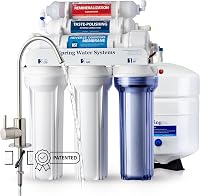
The APEC ROES-50 and iSpring RCC7AK-BN are tank systems; the Waterdrop G3P600 is tankless. For a broader look at tank models, see our guide to under-sink reverse osmosis systems, or compare tankless options in our tankless reverse osmosis guide.


Tank vs tankless reverse osmosis: which fits your cabinet?
Tankless RO can open up cabinet space, while a tank system needs room for both its filter unit and storage vessel. Measure the full cabinet and account for the plumbing, drain line, outlet and items you plan to keep there.
The Waterdrop G3P600 measures 18.12 x 5.67 x 17.72 inches. Waterdrop says its tankless design saves 70% of under-sink space, but the unit still needs a clear area for installation and filter access.
The APEC ROES-50 measures 15.5 x 5.25 x 17 inches, and its included tank adds to the space needed. The iSpring RCC7AK-BN measures 15.5 x 16 x 18 inches and also includes a storage tank.
Those body dimensions don't show the full installation footprint. Measure the tank, tubing and access needed to change filters, then compare them with the cabinet's usable space.
How to measure for tank vs tankless RO
Start by measuring cabinet width, depth and height, including space around pipes and the drain. Check whether the cabinet door closes with the system in place.
Mark the proposed unit and tank positions with painter's tape. Leave the path to shutoff valves clear and make sure you can reach filter housings without removing stored items.
A tankless design can be a better match for a crowded cabinet, but it doesn't remove the need for a drain connection or room for the unit itself. For a complete layout checklist, use our under-sink RO installation guide.
Do tank and tankless systems need different power setups?
The G3P600 needs under-sink electricity, so it needs an accessible outlet; the APEC and iSpring tank options don't require that powered setup. Check the power instructions for the exact model and keep electrical connections away from leaks.
The G3P600 is corded electric. Waterdrop also notes that the system requires under-sink electricity, so a nearby kitchen outlet is part of the installation plan.
The iSpring RCC7AK-BN description says it operates without electricity. The APEC ROES-50 has an AC power-source label, so check its installation instructions and your kitchen's electrical setup before deciding.
Don't assume that every tankless system has the same power needs. If there is no outlet under the sink, compare a tank system's requirements with the work and cost of adding a suitable outlet.
Which style gives you water faster?
A tank system draws from stored filtered water, while the G3P600 advertises an 8-second fill for an 8 oz cup. Your actual experience depends on the setup, water pressure and how much water is being used.
The G3P600 has a stated 600 GPD capacity and a maximum flow rate of 0.42 GPM. Waterdrop says it fills an 8 oz cup in 8 seconds.
The APEC ROES-50 is rated at 50 GPD, and the iSpring RCC7AK-BN at 75 GPD. Those daily production figures are not a direct measure of how quickly water will come from a faucet at a given moment.
A storage tank holds a reserve, which can help when several people draw water close together. If your tank takes too long to refill, see common reasons an RO tank won't fill.
How do water use and drainage compare?
The G3P600 has a stated 2:1 pure-to-drain ratio, but the provided product details don't give matching ratios for the two tank systems. Compare water-use claims for the exact model rather than assuming all systems of one style behave alike.
Waterdrop says the G3P600 produces 2 cups of filtered water for every 1 cup of drain water. A ratio alone doesn't show how much water your household will use over a week, since that depends on your filtered-water use.
The APEC and iSpring details here don't include a comparable drain ratio. If water waste is a key concern, read our explanation of why reverse osmosis systems send water to the drain and review the exact model's documentation.
What maintenance should you expect?
Both styles need filter changes, and the specific schedule depends on the model and your incoming water. Check replacement-filter availability and the maker's schedule before you buy.
The G3P600 has a filter-life tracker on its smart display faucet, and Waterdrop says you can change a filter in 3 seconds without tools. That can make routine changes easier to track.
APEC recommends filter replacement every 6–24 months based on incoming water quality. The iSpring lists replacement filter sets for different intervals, including 6-month, 1-year, 2-year and 3-year options.
Those intervals don't mean every stage has the same schedule. Our guide to how often to change reverse osmosis filters explains how to plan replacements without treating one interval as universal.
Which tank or tankless system should you choose?
Pick a tank system if you want stored water or don't have under-sink power; pick a tankless system if cabinet space is tight and you have an outlet. Match the model to your cabinet measurements and the way your household draws water.
The APEC ROES-50 is a straightforward tank option with a 50 GPD capacity and colored tubing for setup. The iSpring RCC7AK-BN adds a mineral AK stage and has a 75 GPD rating.
The Waterdrop G3P600 suits a tighter cabinet and has a 600 GPD rating, a smart display faucet and a stated 2:1 pure-to-drain ratio. Its need for under-sink electricity is a firm planning point.
For the wider decision between filtration approaches, see our comparison of reverse osmosis and water softeners. Choose by cabinet space, power access and the features you will use.
Tank vs tankless reverse osmosis: what is the quick decision?
Choose tankless when you need to preserve cabinet space and can provide electricity; choose a tank when stored water or a non-powered setup matters more. Measure the cabinet before ordering and check the faucet, drain and filter access needs for the exact model.
If you want to compare specific tank systems next, start with our under-sink tank RO guide. If cabinet space is the main issue, use the tankless RO guide.
Frequently asked questions
Is tankless reverse osmosis better than a tank system?
Tankless reverse osmosis is better when cabinet space is tight and an under-sink outlet is available. A tank system is a better fit when you want stored water or lack power under the sink.
Compare the exact unit dimensions, faucet needs and plumbing before choosing.
Does a tankless reverse osmosis system need electricity?
Some tankless systems need electricity. The Waterdrop G3P600 requires under-sink electricity, so check for an accessible outlet before buying.
The APEC ROES-50 and iSpring RCC7AK-BN are tank systems, and the iSpring description says it operates without electricity.
Do tankless RO systems save more cabinet space?
A tankless RO system can leave more cabinet space because it does not use a separate storage tank. Waterdrop says the G3P600 saves 70% of under-sink space, but the system still measures 18.12 x 5.67 x 17.72 inches.
Measure around plumbing and stored items.
Which reverse osmosis system has more capacity?
The Waterdrop G3P600 is rated at 600 gallons per day, compared with 50 GPD for the APEC ROES-50 and 75 GPD for the iSpring RCC7AK-BN. Those capacity figures don't tell you how the system will perform with your home's water pressure and usage.
Can a tankless RO system work without a power outlet?
The Waterdrop G3P600 cannot work without under-sink electricity, according to its requirements. If there's no outlet, consider a tank system such as the APEC ROES-50, and confirm the exact system's power needs and installation instructions before buying.