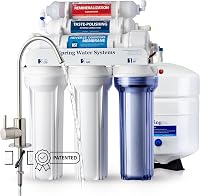
8 Best Tankless Reverse Osmosis Systems for Tight Cabinets (October 2026)
The best tankless reverse osmosis systems for tight cabinets include the Waterdrop G3P600 for a narrow cabinet, the Waterdrop G2P600 for a shorter cabinet, and the Waterdrop G3P800 for higher daily demand.
On this page (9 sections)
- Which tankless reverse osmosis systems suit tight cabinets?
- How we chose these tankless RO systems
- What should you measure before buying a tankless RO system?
- Which measurements matter most in a narrow cabinet?
- Does tankless mean no storage tank at all?
- What do capacity and drain ratios tell you?
- Do tankless RO systems need electricity?
- How do filters and faucet holes affect installation?
- Which tankless reverse osmosis system should you choose?
The best tankless reverse osmosis system for most tight cabinets is the Waterdrop G3P600, which measures 5.67 in wide and has a smart faucet with TDS and filter-life displays. For a shorter cabinet, the Waterdrop G2P600 stands 14 in high; for a cabinet without an outlet, consider the Glacier Fresh GFU03.
Measure the cabinet's usable space before comparing filtration stages or flow claims. Record width, depth and height, then account for tubing bends, shutoff access, the faucet connection and room to pull filters out.
Tankless systems remove the separate storage tank, but they still need a place to sit and space for service. Our plain guide to under-sink reverse osmosis systems covers the basic parts and setup tradeoffs, while tank vs tankless reverse osmosis helps decide which layout fits your sink.
Our picks at a glance
-
1

-
2
-
3

Which tankless reverse osmosis systems suit tight cabinets?
The G3P600 is the best fit for a narrow cabinet, while the G2P600 and G2 offer the shortest listed height. Compare the system body measurements below with your cabinet, then leave working room for the connections and filter changes.
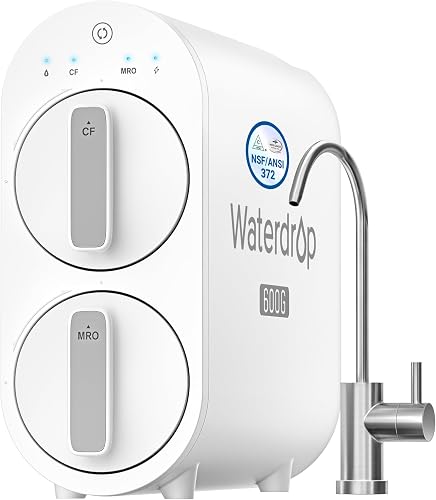
Waterdrop G3P600: Best for a narrow cabinet
- 18.12 x 5.67 x 17.72 in
- 600 GPD
- 2:1 pure-to-drain ratio
- Smart display faucet
Its 5.67 in width is the smallest stated width in this group. The smart faucet shows TDS and filter life.
Pros
- Narrow stated width
- Smart display faucet
- Twist-in filter changes without tools
Cons
- Requires under-sink electricity
- Needs space for faucet and drain connections
Waterdrop G2P600: Best for a shorter cabinet
- 17.3 x 5.9 x 14 in
- 600 GPD
- 2:1 pure-to-drain ratio
- Filter life indicators
At 14 in high, it is the shortest unit in this roundup. Filter life indicators and twist-and-pull cartridges simplify routine changes.
Pros
- Shortest stated height here
- 600 GPD capacity
- Filter life indicators
Cons
- Requires electricity
- Check clearance for plumbing and cartridge access
Waterdrop G3P800: Best for higher daily demand
- 18.12 x 5.67 x 17.72 in
- 800 GPD
- 3:1 pure-to-drain ratio
- Smart faucet with LED
It shares the G3P600's stated dimensions and offers 800 GPD capacity with a 3:1 pure-to-drain ratio. Its smart faucet displays TDS.
Pros
- 800 GPD capacity
- 3:1 pure-to-drain ratio
- Smart faucet with LED
Cons
- Requires electricity
- Same cabinet dimensions as the taller G3P600
iSpring RO500AK: Best for alkaline remineralization

- 17.5 x 5.2 x 16.25 in
- 500 GPD
- 2:1 pure-to-drain ratio
- Alkaline remineralization
The 5.2 in width is the narrowest stated measurement here. Its alkaline filter adds minerals to RO-filtered water.
Pros
- Narrow 5.2 in width
- Alkaline remineralization filter
- Filter reminders
Cons
- Requires electricity
- Needs space for faucet and connections
Waterdrop T3-M: Best for mineral-infused water

- 13.39 x 6.22 x 17.95 in
- 450 GPD
- 2:1 pure-to-drain ratio
- Remineralization filter
Its 13.39 in length is the shortest stated dimension in this set. It adds minerals and includes smart filter alerts.
Pros
- Short stated length
- Remineralization filter
- Smart filter alerts
Cons
- Requires power
- Faucet installation requires a drilled hole
Glacier Fresh GFU03: Best for a cabinet without an outlet

- 13.58 x 8.27 x 16.54 in
- 800 GPD
- 3:1 pure-to-drain ratio
- No electric drive
Its water-powered design does not need an electrical outlet. The 8.27 in width takes more cabinet space than the other listed units.
Pros
- No electric drive
- 800 GPD capacity
- 3:1 pure-to-drain ratio
Cons
- Widest unit in this group
- Needs extra room for tubing and filter changes
Waterdrop G2: Best for a 14 in cabinet height

- 17.3 x 5.9 x 14 in
- 400 GPD
- 1:1 pure-to-drain ratio
- Twist-and-pull filters
Its 14 in height suits cabinets with limited vertical room, provided there is clearance for connections. It uses a 1:1 pure-to-drain ratio.
Pros
- 14 in stated height
- Twist-and-pull filters
- Tankless design
Cons
- Requires electricity
- Lower stated capacity than the 600 and 800 GPD options
iSpring RCC1DP: Best for aquariums and lab use

- 14.2 x 8.5 x 17.7 in
- 150 GPD
- Built-in pump
- RO and deionization
This RO/DI system is aimed at aquariums, labs and similar uses, with a built-in pump for low-pressure settings. Its 8.5 in width is the largest stated width here.
Pros
- Built-in pump
- RO and deionization filtration
- Designed for aquarium and lab use
Cons
- 150 GPD capacity
- Wide cabinet footprint for this roundup
| Product | Best for | Size (L x W x H) | Capacity | Power | Our score |
|---|---|---|---|---|---|
| Waterdrop G3P600 | a narrow cabinet | 18.12 x 5.67 x 17.72 in | 600 GPD | Corded electric | 8.8 |
| Waterdrop G2P600 | a shorter cabinet | 17.3 x 5.9 x 14 in | 600 GPD | Corded electric | 8.2 |
| Waterdrop G3P800 | higher daily demand | 18.12 x 5.67 x 17.72 in | 800 GPD | Corded electric | 8.0 |
| iSpring RO500AK | alkaline remineralization | 17.5 x 5.2 x 16.25 in | 500 GPD | Corded electric | 7.9 |
| Waterdrop T3-M | mineral-infused water | 13.39 x 6.22 x 17.95 in | 450 GPD | Plug-in required | 7.4 |
| Glacier Fresh GFU03 | a cabinet without an outlet | 13.58 x 8.27 x 16.54 in | 800 GPD | No electric drive | 7.2 |
| Waterdrop G2 | a 14 in cabinet height | 17.3 x 5.9 x 14 in | 400 GPD | Corded electric | 7.7 |
| iSpring RCC1DP | aquariums and lab use | 14.2 x 8.5 x 17.7 in | 150 GPD | Corded electric | 6.9 |
How we chose these tankless RO systems
We compared the stated dimensions, capacity, drain ratio, power needs and features that affect cabinet planning. We gave more weight to narrow or short dimensions, clear service details and practical differences such as remineralization or a pump.
A published body dimension is only a starting point. Before you buy, confirm the faucet hole, drain connection, electrical access if needed, and clearance to remove each cartridge.
The Waterdrop G3P600 leads because it combines a narrow 5.67 in body with a smart faucet and a stated 2:1 pure-to-drain ratio. The G2P600 and G2 suit shorter cabinets, while the non-electric GFU03 may fit sinks without a nearby outlet.
What should you measure before buying a tankless RO system?
Measure the cabinet's internal width, depth and height at the exact spot where the unit will sit. Pipes, disposal units, shelves and cabinet hinges can reduce usable space.
Check the filter service path as well as the unit footprint. A cartridge that pulls forward needs enough open space in front of the system, while a twisting cartridge needs room for your hand to turn it.
Also map the tubing route from the cold-water feed to the drain connection and faucet. Avoid tight bends, and make sure you can still reach the shutoff valve after installation.
Some systems require an electrical outlet under the sink. If yours does, confirm that the outlet is accessible and that the cord can stay clear of water lines and stored items.
Which measurements matter most in a narrow cabinet?
Width is the first constraint when a disposal or water line takes up one side of the cabinet. The iSpring RO500AK is 5.2 in wide, while the G3P600 and G3P800 are each 5.67 in wide.
Height matters when a shelf or the sink bowl sits low. The G2P600 and Waterdrop G2 are each 14 in high, shorter than the other listed systems.
Depth can be easy to overlook because a unit may extend toward the cabinet door. The G3P600 is 18.12 in long, while the T3-M is 13.39 in long, but compare the measurement orientation with the space available in your cabinet.
Keep a little extra room around the system for lines and filter service. Exact clearance needs can vary with the installation, so use the model instructions before drilling or connecting pipes.
Does tankless mean no storage tank at all?
A tankless reverse osmosis system does not use the separate pressurized storage tank found in many traditional under-sink RO setups. It filters water as needed, so the system itself still occupies cabinet space.
That difference can help in a crowded cabinet, but it doesn't guarantee a fit. For a closer comparison of cabinet layout, output and water storage, see our tank versus tankless RO comparison.
Consider your use pattern as well as the footprint. If you often fill several containers at once, compare capacity and flow claims, and think about how much room remains for a pitcher or cleaning supplies.
What do capacity and drain ratios tell you?
Capacity, shown here in gallons per day, is a stated production figure rather than a guarantee of the amount you'll get in your kitchen. Water pressure and other conditions can affect flow, so check the system's operating requirements and installation notes.
The pure-to-drain ratio compares filtered water with wastewater. The G3P800 and GFU03 state a 3:1 ratio, while the G3P600, G2P600, RO500AK and T3-M state 2:1; the Waterdrop G2 states 1:1.
A higher capacity may be useful for a busy household, but cabinet size and service access still come first in a tight space. Our Waterdrop G3P800 vs X8 comparison looks more closely at one higher-capacity tankless option.
Do tankless RO systems need electricity?
Most of the electric tankless systems here need an outlet under the sink. The G3P600, G2P600, G3P800, RO500AK, T3-M, Waterdrop G2 and RCC1DP are listed as corded or plug-in models.
The Glacier Fresh GFU03 is described as water-powered and requiring no electric drive. That can make it worth considering where an outlet is unavailable, though its 8.27 in width is the broadest stated width in this group.
Check outlet placement before buying a powered system. Keep the plug reachable and route the cord away from leaks and moving cabinet parts.
How do filters and faucet holes affect installation?
Filter replacement can require more room than the unit's dimensions suggest. The G3P600, G2P600 and G2 use twist-style filters, while the G3P800 uses a front-pull design; check that the service motion is possible with your cabinet doors open.
Many tankless RO setups use a dedicated faucet, and some installations need drilling. The T3-M specifies a drilled faucet hole, and the GFU03 calls for a hole in the sink; check your sink material and existing holes before planning the work.
For a step-by-step overview of common under-sink connections, see how to install under-sink reverse osmosis. After installation, follow the model manual for flushing and filter setup.
Which tankless reverse osmosis system should you choose?
Choose the Waterdrop G3P600 if your cabinet is narrow and you want a display faucet. Pick the G2P600 or G2 if the available height is the main limit, and consider the iSpring RO500AK if you want an alkaline remineralization filter in a narrow body.
Choose the Glacier Fresh GFU03 when avoiding an electrical connection matters and the wider body fits. For a shorter unit with remineralization, the Waterdrop T3-M has the shortest stated length in this group.
Measure the actual cabinet and plan for connections before ordering. If you're still comparing system layouts, start with our under-sink RO buyer's guide.
Sources
- NSF: Reverse Osmosis Drinking Water Treatment Systems
- U.S. Environmental Protection Agency: Home Drinking Water Filtration Fact Sheet
Related reading
- How often to change reverse osmosis filters
- Why reverse osmosis systems waste water
- Best under-sink reverse osmosis systems with a tank
Our top 3 picks at a glance
-
1
-
2
-
3
Frequently asked questions
What size tankless reverse osmosis system fits a tight cabinet?
Measure the cabinet's clear width, depth and height, then compare all three with the system dimensions. Leave extra room for tubing, shutoff access and cartridge changes.
A unit's body size alone doesn't show how much working space the plumbing needs.
Do tankless reverse osmosis systems need an outlet?
Most models in this roundup require electricity, including the Waterdrop and iSpring systems. The Glacier Fresh GFU03 is described as having no electric drive.
Check outlet access and cord routing before choosing a powered unit.
Does a tankless RO system save cabinet space?
A tankless design removes the separate storage tank used by many traditional RO systems, which can free cabinet room. The filter unit still takes space, and its connections and service access need room too.
Compare dimensions before choosing by the tankless label alone.
What does a pure-to-drain ratio mean?
A 2:1 pure-to-drain ratio means the system produces 2 parts filtered water for each 1 part wastewater, based on the stated ratio. A 3:1 ratio produces 3 parts filtered water per 1 part wastewater.
Actual performance can depend on water conditions and setup.
Can I install a tankless RO system myself?
Some systems are designed for home installation, but the work can involve a faucet hole, drain connection, water shutoff and an electrical outlet. Read the model's instructions and check your sink setup before starting.
If drilling or plumbing changes are outside your comfort level, use a qualified installer.