8 Best Reverse Osmosis System Under $300 (October 2026)
The best reverse osmosis systems under 300 dollars include the iSpring RCC7AK-BN for a mineral stage, the APEC ROES-50 for a five-stage tank setup, and the Waterdrop G5P500A for tankless mineral filtration.
On this page (6 sections)
- How we chose reverse osmosis systems under 300 dollars
- Best reverse osmosis systems under 300 dollars for different kitchens
- What should you check before buying an RO system?
- Is a tank system or a tankless system the better value?
- How do you choose the right system for your budget?
- Frequently asked questions
The iSpring RCC7AK-BN is our best reverse osmosis system under 300 dollars for buyers who want a tank, a mineral stage and a faucet fastener that tightens from above the counter. If you prefer a simpler five-stage setup, consider the APEC ROES-50; if cabinet space is tight, compare the tankless Waterdrop G5P500A.
A budget cap doesn't tell you whether a system will fit your sink or suit your routine. Check cabinet room, access to power, countertop drilling, filter changes and whether you want a tank before picking a model.
See our under-sink reverse osmosis system guide for the basic parts and fit questions. If you want a wider set of tank models, compare our best under-sink reverse osmosis systems with a tank.
Our picks at a glance
-
1
-
2

-
3

How we chose reverse osmosis systems under 300 dollars
We compared stated filtration stages, tank style, installation details, included parts and maintenance information against the needs of a buyer setting a firm budget. Our score weighs specs, features and buyer feedback against what you're shopping for.
The picks include both tank and tankless designs because those layouts solve different space and access needs. A tank adds a separate container under the sink, while tankless models need electricity and may call for countertop drilling.
Certification details also matter, but they vary by model. For example, iSpring says the complete RCC7AK system is certified to NSF/ANSI 58, while Waterdrop G2 is certified to NSF/ANSI 372 for lead-free materials.
A certification applies to the claims and scope named for that system. For more on choosing a tank layout and comparing features, see our tank vs tankless reverse osmosis comparison.
| Product | Best for | System style | Stages | Stated capacity | Our score |
|---|---|---|---|---|---|
| iSpring RCC7AK-BN | a mineral stage | Under sink with storage tank | 6 | 75 gallons per day | 9.1 |
| APEC ROES-50 | a five-stage tank setup | Under sink with storage tank | 5 | 50 gallons per day | 8.9 |
| Waterdrop G5P500A | tankless mineral filtration | Tankless under sink | 8 | 500 gallons per day | 8.6 |
| Express Water RO5DX | included extras | Under sink with storage tank | 5 | 50 gallons per day | 7.8 |
| Waterdrop G2 | a compact tankless system | Tankless under sink | 7 | 400 gallons per day | 7.7 |
| Waterdrop T3-C | filter alerts | Tankless under sink | 8 | 450 gallons per day | 7.3 |
| Geekpure 5-Stage 75 GPD | spare filters in the box | Under sink with storage tank | 5 | 75 gallons per day | 7.0 |
| PureDrop RTW5 | extra prefilters | Reverse osmosis with storage tank | 5 | 6.8 |
Best reverse osmosis systems under 300 dollars for different kitchens
The iSpring leads this group because its listed features include a mineral stage, a tank and a top-mounted faucet fastener. The other systems earn their place through different priorities, including extra filters, a compact tankless layout or appliance connections.
iSpring RCC7AK-BN: Best for a mineral stage
- Six-stage filtration
- Storage tank
- Top-mounted faucet fastener
- NSF/ANSI 58 certified system
A tank system with a mineral stage and a faucet fastener designed for installation from above the counter. iSpring says the complete system is certified to NSF/ANSI 58.
Pros
- Mineral stage
- Top-mounted faucet fastener
- Transparent first-stage housing
Cons
- Uses cabinet space for a tank
- Faucet installation still needs a countertop opening
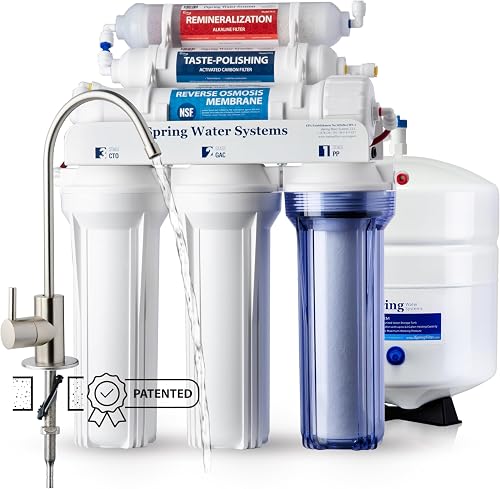
The iSpring RCC7AK-BN is the clearest match if you want a tank system with remineralization. Its six-stage design includes a natural mineral AK stage, and the first-stage housing is transparent so you can see sediment buildup.
Its top-mounted fastener is designed to make faucet installation easier from above the counter. The system includes a brushed nickel faucet and storage tank, and iSpring says the whole system is NSF/ANSI 58 certified.
Before buying, measure the cabinet with room for both the filter assembly and tank. The listed dimensions for the system are 15.5 x 16 x 18 in, and a faucet opening is still part of the installation plan.
APEC ROES-50: Best for a five-stage tank setup
- Five-stage filtration
- Storage tank
- Quick connection fittings
- Includes a filter set
This under-sink system keeps the setup familiar: five filtration stages, a tank, faucet and installation kit. APEC recommends filter changes every 6–24 months based on incoming water quality.
Pros
- Tank and faucet included
- Quick connection fittings
- Filter set included
Cons
- Tank takes cabinet room
- Replacement timing depends on incoming water quality
The APEC ROES-50 suits buyers who want a five-stage tank system with the basic installation parts together. Its package includes a filter set, brushed nickel faucet, tank, installation kit and instructions.
APEC recommends replacing filters every 6–24 months based on incoming water quality. That range makes it useful to check replacement-filter cost and timing for your household rather than assume every cartridge follows the same schedule.
The system's stated capacity is 50 gallons per day. Compare that figure with your likely daily use, while remembering that feed water and operating conditions can affect real output.
Waterdrop G5P500A: Best for tankless mineral filtration
- Tankless design
- Alkaline mineralization stage
- Stated 500 GPD capacity
- 2:1 pure-to-drain ratio
A tankless option with alkaline mineralization and a stated 2:1 pure-to-drain ratio. The faucet needs a drilled countertop hole, and connecting an ice maker or fridge is supported.
Pros
- No storage tank
- Mineralization stage
- Appliance connections supported
Cons
- Needs a countertop hole for the faucet
- Requires an electrical connection
Choose the Waterdrop G5P500A if you want tankless filtration with a mineralization stage. Its eight-stage design includes alkaline mineralization, and Waterdrop gives a 2:1 pure-to-drain ratio.
The faucet needs a hole drilled in the countertop, and the system requires an electrical connection. It can connect to an ice maker or fridge, which may help if you want filtered water at another outlet.
Waterdrop states a 500 GPD capacity and says the system fills a 6-ounce cup in 8 seconds. Those are maker figures, so use them as a point of comparison rather than a guarantee for your home's water pressure and setup.
Express Water RO5DX: Best for included extras

- Five-stage filtration
- Storage tank
- Extra filter set
- Leak detector included
The RO5DX includes an extra filter set and a leak detector, along with its tank and faucet. It operates without power and uses quick-connect tubing.
Pros
- Extra filter set included
- Leak detector included
- No power needed
Cons
- Tank takes cabinet room
- Installation tools are not included
The Express Water RO5DX is a practical pick for buyers who value included maintenance parts. It comes with an extra filter set and a leak detector, plus the tank, faucet and quick-connect tubing.
The system operates without electricity, which can matter if you don't have a convenient outlet under the sink. Express Water says tools are not included, so check your tool drawer before starting a DIY installation.
Its stated capacity is 50 gallons per day, and the system includes a tank. Allow space for that container, and review the supplied installation instructions before routing the drain and feed lines.
Waterdrop G2: Best for a compact tankless system

- Tankless design
- Seven-stage filtration
- Stated 400 GPD capacity
- NSF/ANSI 372 certified
The G2 combines a tankless cabinet setup with a stated 1:1 pure-to-drain ratio. It needs under-sink electricity and a drilled faucet opening.
Pros
- No storage tank
- Two filters included
- Twist-and-pull filter design
Cons
- Requires an electrical outlet
- Faucet installation requires drilling
The Waterdrop G2 fits a kitchen where tank space is limited and an outlet is available. Its tankless design uses a composite filter, and two filters are included.
The G2 needs under-sink electricity, and installation requires drilling for the faucet. Its twist-and-pull filters are designed for replacement without a separate wrench, but you'll still need to keep the correct replacement cartridges on hand.
Waterdrop states a 400 GPD capacity and a 1:1 pure-to-drain ratio. If water use and drain flow are key concerns, read our guide to why reverse osmosis systems waste water.
Waterdrop T3-C: Best for filter alerts

- Tankless design
- Smart filter alerts
- Automatic flushing
- 2:1 pure-to-drain ratio
The T3-C pairs a tankless layout with filter alerts, automatic flushing and an all-in-one cartridge. It needs power, and installing its faucet requires a drilled countertop hole.
Pros
- Filter replacement alerts
- Automatic flushing
- Three pre-installed filters
Cons
- Requires an electrical connection
- Faucet installation needs a countertop hole
The Waterdrop T3-C is for buyers who want filter alerts and automatic flushing in a tankless system. Its all-in-one cartridge is designed for quick replacement, and it has a stated 2:1 pure-to-drain ratio.
This model requires an electrical connection, and faucet installation needs a drilled countertop opening. Its filter schedule varies by cartridge: Waterdrop gives 6 months for the CF filter, 12 months for the CB filter and 24 months for the RO filter.
That schedule is useful for estimating upkeep, but your water and use can affect replacement needs. Read how often to change reverse osmosis filters before planning a maintenance calendar.
Geekpure 5-Stage 75 GPD: Best for spare filters in the box

- Five-stage filtration
- Storage tank
- Seven extra replacement filters
- Color-coded tubing
This tank system includes seven extra replacement filters and uses color-coded tubing for setup. Geekpure says the prefilters last a year and the membrane can last 2–3 years, depending on use and feed water.
Pros
- Seven extra filters included
- Color-coded tubing
- No power needed
Cons
- Installation and flushing take planning
- Replacement timing depends on use and feed water
Geekpure stands out for buyers who want spare filters included up front. The package includes seven extra replacement filters, plus a tank, faucet and color-coded tubing.
Geekpure states a 75 GPD capacity and says its prefilters can last a year, while the RO membrane may last 2–3 years. It also notes that lifespan depends on use and feed-water quality, so treat those time frames as planning guidance.
Installation and flushing take longer than a quick cartridge swap. Geekpure advises allowing 1–2 hours to install and flush the filters, and the first two tanks of water should not be used.
PureDrop RTW5: Best for extra prefilters

- Five-stage filtration
- Storage tank
- Three extra prefilters
- Refrigerator adapters included
The RTW5 includes three extra prefilters and refrigerator adapters for connecting to most refrigerator and icemaker lines. Its top-mount faucet design is intended to reduce awkward work below the sink.
Pros
- Three extra prefilters
- Refrigerator adapters included
- Top-mount faucet design
Cons
- Confirm fit and installation details for your sink
- Its stated maximum flow is 50 liters per hour
The PureDrop RTW5 suits buyers who want extra prefilters and refrigerator adapters in a tank system. Its package includes three extra prefilters, and the included adapters are intended for most refrigerator and icemaker water lines.
The top-mount faucet design is meant to reduce awkward work under the sink. Before choosing it, confirm the faucet opening, cabinet fit and connection needs for your particular sink and refrigerator.
PureDrop describes a 1:2 pure-to-wastewater ratio and says its membrane replacement timing is every 2–3 years depending on source water quality. Those details can help compare upkeep, but check the system instructions for your water and use.
What should you check before buying an RO system?
Before you buy, measure the available cabinet space and confirm whether the system needs electricity or countertop drilling. These checks can rule out a model before you spend time comparing filtration stages.
For a tank system, leave room for both the filter assembly and its storage tank. Tankless models remove the separate tank, but they need an outlet and their faucets may need a drilled opening.
Next, look at what comes in the box and what needs replacing. Some systems include extra filters, while other makers give replacement schedules that vary by cartridge or incoming water quality.
If you're installing the system yourself, make sure you can reach the shutoff valve and drain connection. Our step-by-step installation guide covers the basic process, while our reverse osmosis tank pressure guide can help after setup.
Is a tank system or a tankless system the better value?
A tank system can suit you if you want a setup that operates without an electrical outlet and have cabinet room for storage. The iSpring RCC7AK-BN, APEC ROES-50 and Express Water RO5DX are examples in this group.
A tankless system can save the space used by a separate tank, but it needs electricity. Waterdrop G5P500A, G2 and T3-C are tankless picks here, and each has a faucet installation requirement to check.
Value also depends on filter availability and maintenance costs over time. Read our reverse osmosis system cost guide to include replacement filters and water use in your decision.
How do you choose the right system for your budget?
Choose the iSpring RCC7AK-BN if you want a tank, a mineral stage and a top-mounted faucet fastener. Pick APEC ROES-50 for a straightforward five-stage tank package, or Express Water RO5DX if the extra filter set and leak detector fit your priorities.
Choose the G5P500A if you want a tankless design with mineralization and appliance connections. Consider the G2 for its compact layout and twist-and-pull filters, or the T3-C if filter alerts and automatic flushing matter most.
If you'll use the system with a refrigerator, check the connection parts and installation route before deciding. If you want spare filters included, compare Geekpure and PureDrop, then confirm that the included cartridges are the ones you'll need later.
Frequently asked questions
Can you get a reverse osmosis system under 300 dollars?
Yes. Several under-sink reverse osmosis systems offer a tank, faucet and filter stages in this budget tier.
Compare what comes in the box, the space the system needs, and the cost and timing of future filters.
The system price is only one part of ownership.
Is a tank or tankless reverse osmosis system better?
A tank system stores filtered water in a separate container, while a tankless system skips that container and usually needs electricity. Choose based on cabinet space, power access, water-use habits and installation needs.
Tankless faucets may require a drilled countertop hole.
Do reverse osmosis systems need electricity?
Some do and some do not. The iSpring RCC7AK-BN, APEC ROES-50 and Express Water RO5DX are described as operating without electricity, while the Waterdrop G2 and other tankless picks need a power connection.
Check outlet access under your sink before choosing.
How often should you replace reverse osmosis filters?
Filter timing varies by system and incoming water. APEC recommends intervals from 6 to 24 months based on water quality, while Geekpure gives different expected lives for prefilters and its membrane.
Use the instructions for your exact system and consider your water use.
Our top 3 picks at a glance
-
1
-
2
-
3
Frequently asked questions
Can you get a reverse osmosis system under 300 dollars?
Yes. Several under-sink reverse osmosis systems offer a tank, faucet and filter stages in this budget tier.
Compare what comes in the box, the space the system needs, and the cost and timing of future filters.
The system price is only one part of ownership.
Is a tank or tankless reverse osmosis system better?
A tank system stores filtered water in a separate container, while a tankless system skips that container and usually needs electricity. Choose based on cabinet space, power access, water-use habits and installation needs.
Tankless faucets may require a drilled countertop hole.
Do reverse osmosis systems need electricity?
Some do and some do not. The iSpring RCC7AK-BN, APEC ROES-50 and Express Water RO5DX are described as operating without electricity, while the Waterdrop G2 and other tankless picks need a power connection.
Check outlet access under your sink before choosing.
How often should you replace reverse osmosis filters?
Filter timing varies by system and incoming water. APEC recommends intervals from 6 to 24 months based on water quality, while Geekpure gives different expected lives for prefilters and its membrane.
Use the instructions for your exact system and consider your water use.