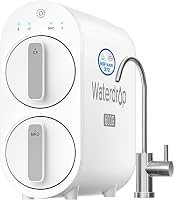
Waterdrop G3P800 Review: Tankless RO Under Sink (November 2026)
The Waterdrop G3P800 is worth buying for a big household that wants fast, tankless RO water and has a cabinet wide enough for its 18.12 in body. Pick the G3P800-WCK if you want a black faucet, or a smaller model if your under-sink space is tight.
On this page (8 sections)
The Waterdrop G3P800 is worth buying for a big household that wants fast, tankless RO water and has a cabinet wide enough for its 18.12 in body. Pick the G3P800-WCK if you want a black faucet, or a smaller model if your under-sink space is tight.
The Waterdrop G3P800-RO Filter is the replacement you'll buy most often once the system is running. It snaps in with a twist and pull, so the upkeep is quick.
The Waterdrop G3P800 at a glance
The G3P800 is a 10-stage tankless RO system rated at 800 gallons per day. It filters water through a membrane and carbon blocks without a storage tank, and its smart faucet shows the TDS level so you can see water quality at a glance.
Waterdrop G3P800: Best for big households

- 800 gallons per day
- 10-stage filtration
- 3:1 pure to drain ratio
- Smart faucet with LED display
A high-capacity tankless system with a smart faucet and a 10-stage filter stack. It suits households that fill glasses and cooking pots all day and can give it the cabinet width it needs.
Pros
- 800 GPD for a large family
- 3:1 pure to drain ratio
- 10-stage filtration with NSF/ANSI 42, 53, 58 and 372 certification
- Smart faucet shows TDS and water quality
- Tankless design frees up under-sink space
Cons
- 18.12 in long body needs a roomy cabinet
- Needs a power outlet under the sink
- Higher capacity costs more than the smaller G3P600
The 3:1 pure to drain ratio means it sends three cups of filtered water down the drain for every one it wastes. That matters if you drink a lot of water and don't want to watch a stream of wastewater leave the house.
What you get in the box
Waterdrop ships the system with three filters already installed, plus the smart faucet and the user manual. That means the first install is plumbing and mounting work, not a filter assembly job.
It's a corded electric unit, so plan for an outlet inside the cabinet.
The filter stack itself is the other thing to know. Waterdrop lists five filters in this family: the G3P800-RO membrane, the G3-N1CF and G3-N3CB filters, the G3P600-RO filter and the G3-N2RO filter.
Only the G3P800-RO is built for this 800 GPD body, and the included components name that single RO replacement filter. The rest of the stages are the supporting filters in the stack.
Who the Waterdrop G3P800 suits
Buy it if your household fills glasses, bottles, coffee makers and cooking pots all day and you want water on demand without a tank taking up cabinet space. A family of four or more that goes through water quickly is the natural fit for 800 GPD.
Skip it if your cabinet is shallow or narrow. The system measures 18.12 in long and 17.72 in tall, and a tankless unit still needs room for the plumbing and the faucet line.
If your sink base is tight, a slimmer tankless reverse osmosis system may fit better.
Skip it too if there's no power outlet under the sink. A corded system can't run without one, and adding an outlet is extra cost and work.
Specs that matter in daily use
The numbers that change how the G3P800 feels day to day are flow rate, pure to drain ratio, filtration stages and footprint. The 800 GPD capacity is the headline: Waterdrop says it filters one cup in about 5 seconds.
That's the difference you notice when you're filling a pot for pasta.
The 3:1 pure to drain ratio keeps wastewater lower than older RO designs. Over a year of daily drinking, that adds up, especially in areas where water is metered.
Ten stages of filtration cover the basics and more. Waterdrop says the system reduces PFAS, fluoride, heavy metals like lead and chromium, nitrate and chloride, plus large particles and radioactive substances such as radium.
It's certified to NSF/ANSI 42, 53, 58 and 372, which covers chlorine, bad taste and odor, TDS reduction and lead-free materials.
The smart faucet adds a TDS readout and a filter-life light. You don't need to remember replacement dates, because the faucet tells you when a filter is due.
The LED lamp also turns on when water flows, which helps in a dim cabinet.
Waterdrop puts the LED lamp's lifespan at up to 50 years. That's a long-lived part for something that runs every time you pour a glass.
The 0.0001 micron membrane rating sits behind the 10 stages and does the fine work after the carbon blocks and PP cotton have taken out the larger material.
The footprint in real terms
The body is 18.12 in long, 5.67 in wide and 17.72 in tall. It weighs about 15.3 kg.
A tall, narrow shape fits many cabinets better than a tank, but you still need clearance around it for the water lines and the filter pull path. The front-pull design means you change filters from the front, so leave a little space in front of the unit.
Check the height against your sink plumbing too. A tall unit can foul the drain pipe or the disposal if the cabinet is shallow, so measure the clear vertical space and not just the floor area.
Setting up the G3P800
Setup is an under-sink plumbing job: mount the system, connect the feed water line and the faucet, and plug it in. Waterdrop's front-pull filter design makes later changes easy, but the first hookup is the part that takes time.
Clear the cabinet first. Remove what's stored under the sink, check that the outlet works, and shut off the water supply before you start.
Mount the unit where the filter pull path stays clear and the water lines can reach without kinks.
Connect the feed line to your cold water supply and run the faucet line up through the sink. The smart faucet needs its cable routed to the system, so plan that alongside the water tubing.
Run the system and let it flush as the manual directs before you drink the water. Then check for drips at every connection and look at the TDS reading on the faucet to confirm the system is filtering.
If plumbing isn't your thing, budget for a plumber. The install is straightforward for someone comfortable with under-sink work, but a leak behind a cabinet is a costly mistake.
Keeping the install within the water's limits
The system states a maximum supported TDS of 500 ppm, so check your supply before you mount anything. A TDS meter is cheap and tells you whether the G3P800 is working within its range or being asked to do too much.
The lower temperature rating is 41 °F, so the feed water shouldn't come in colder than that on a regular basis.
If you're on well water or a supply with a lot of sediment, test first and ask Waterdrop whether the G3P800 suits your water. Installing a system outside its stated limits shortens membrane life and can leave you replacing filters early.
Care and filter changes
Care is mostly filter changes and an occasional check for leaks. The smart faucet's filter-life light takes the guesswork out of timing, and the front-pull filters change in seconds.
The RO membrane is the long-life stage. The pre-filters before it do the heavy lifting on sediment and chlorine and usually need changing more often.
Follow Waterdrop's replacement schedule for each stage rather than swapping everything at once.
The Waterdrop G3P800-RO Filter is the one to keep in mind for the membrane stage. It's built only for this system and uses an enlarged membrane area to hit the 3:1 drain ratio.
A twist and pull swaps it in about 3 seconds, so you don't need a plumber for routine changes.
Check the connections under the sink every few months. Look for damp spots, cracked tubing or a loose fitting.
Wipe the cabinet floor dry so a slow leak shows up before it warps the shelf.
If your water pressure or TDS changes a lot, watch the faucet display. A rising TDS reading with a fresh filter can point to a membrane that's past its best.
That readout is the simplest maintenance signal the system gives you, and it's worth glancing at now and then between filter changes.
Trade-offs to weigh before you buy
The main trade-offs are size, power and the higher cost of an 800 GPD system. Tankless units save cabinet space compared with a tank, but this one still needs a long, tall spot and an outlet.
The 18.12 in length is the biggest limit. Measure your cabinet's interior before you order, and check the height too, because 17.72 in plus the water lines can crowd a shallow base.
The system needs electricity. That's normal for tankless RO, but it means the outlet is part of the decision, not an afterthought.
If your cabinet has no outlet, price in an electrician.
Higher capacity also costs more than a smaller tankless model. If your household is two people, a 600 GPD system may cover your drinking and cooking without paying for capacity you don't use.
The Waterdrop G3P600 review covers that option.
Finally, the smart faucet is a nice extra, but it's one more part to route and connect. The black version adds a finish choice on top of that.
The replacement filters add up
The G3P800 takes the G3P800-RO membrane plus the supporting filters in its stack, and each stage has its own replacement interval. The smart faucet's filter-life light tracks them separately, which helps you avoid buying a full set when only one stage is due.
Budget for filters as a running cost, not a one-time purchase. The membrane lasts longer than the pre-filters, so the early replacements tend to be the cheaper stages.
Keeping to the schedule protects the membrane and keeps the 3:1 drain ratio where Waterdrop rates it.
Alternatives worth a look
The G3P800 isn't the only tankless RO in this size class. These three are the closest comparisons, each with a clear reason to pick it.
Waterdrop G3P800-WCK
The WCK version is the same system with a black smart faucet. It runs the same 10-stage filtration, 800 GPD capacity and 3:1 pure to drain ratio.
The difference is the finish and the faucet's independent inner waterway, which keeps filtered water away from the metal surfaces.
Pick it if your kitchen has dark fixtures and you want the faucet to match. It also carries the same smart display with real-time TDS and a filter-life indicator.
The system is certified to NSF/ANSI/CAN 372 for low lead content, and Waterdrop says its filtration was evaluated through SGS and CSA testing. It takes the same G3P800-RO replacement filter, so the upkeep is identical.
Waterdrop G3P600
The Waterdrop G3P600 review shows a smaller tankless RO for busier kitchens with less cabinet room. It's the better fit for a two-person household or a tight sink base, where 800 GPD is more capacity than you need.
Waterdrop G3P800 vs X8
The Waterdrop G3P800 vs X8 comparison puts this system against Waterdrop's X8 model. Read it if you're choosing between the two and want to see which one fits your cabinet and your daily water use.
Waterdrop G2P600
The Waterdrop G2P600 review covers an even smaller tankless option. It's worth a look if you want RO water but your under-sink space is very limited.
The verdict
Buy the Waterdrop G3P800 if your cabinet fits it and your household drinks a lot of water. It's a strong tankless RO for big families, with 800 GPD, 10-stage filtration and a smart faucet that shows water quality.
Choose the G3P800-WCK if you want the black faucet and matching finish. Go with the smaller G3P600 or G2P600 if your cabinet is tight or your household is small.
And if you're still weighing tankless against a tank, the tankless reverse osmosis system guide helps you decide.
Our score weighs specs, features and buyer feedback against what you're shopping for. On those waterdrop g3p800 reviews, the system earns an 8 for big households with room to spare.
Frequently asked questions
How often do you change the filters on the Waterdrop G3P800?
The G3P800 uses front-pull filters that twist out in about 2 seconds, and the smart faucet's filter-life light tells you when each one is due. Replace each stage on the schedule Waterdrop gives for that filter, not all at once.
Does the Waterdrop G3P800 need electricity?
Yes. It's a corded electric tankless system, so you need a working outlet in the under-sink cabinet.
Factor that in before you buy, because a system without a nearby outlet won't run.
Can the Waterdrop G3P800 handle well water?
Waterdrop states a maximum supported TDS of 500 ppm for this system. If your water reads above that, test it first and ask Waterdrop whether the G3P800 is suitable for your supply before installing.
Is the Waterdrop G3P800 hard to install?
It's an under-sink system, so you'll need to mount it in the cabinet, connect the water line and faucet, and plug it in. Waterdrop describes quick front-pull filter changes, but the first plumbing hookup still calls for basic DIY comfort or a plumber.