How Does a Tankless RO System Work?
A tankless RO system pushes tap water through a pump and a reverse osmosis membrane as soon as you open the faucet, so filtered water arrives on demand. It skips the storage tank, which frees up cabinet space and means each glass is freshly filtered rather than sitting in a tank.
On this page (10 sections)
- What parts make up a tankless RO system?
- How does water move through a tankless RO system step by step?
- Why is there no storage tank, and what changes without one?
- How does the RO membrane remove contaminants?
- How does the drain ratio affect water waste?
- Why does a tankless RO system need electricity?
- How do smart faucets and filter tracking work?
- How do you install and maintain a tankless RO system?
- What should you know before buying a tankless RO system?
- How does a tankless RO system work in daily use?
A tankless RO system pushes tap water through a pump and a reverse osmosis membrane as soon as you open the faucet, so filtered water arrives on demand. It skips the storage tank, which frees up cabinet space and means each glass is freshly filtered rather than sitting in a tank.
If you've only used a traditional under-sink RO with a big pressure tank, the tankless version looks different. It's smaller, it needs electricity, and it filters while you draw instead of filling a tank in advance.
The basic idea is simple once you see the parts in order.
What parts make up a tankless RO system?
Five main parts do the work: a sediment and carbon pre-filter, a booster pump, the RO membrane, a post-filter, and the smart faucet. Water moves through them in that order each time you open the tap.
The pre-filter catches sediment, rust and chlorine before water reaches the membrane. The pump then pushes water at the pressure the membrane needs to separate dissolved solids.
The membrane is the core stage, rejecting most contaminants. A final carbon stage polishes taste before the water leaves the faucet.
There's no storage tank in the cabinet. A small flow sensor tells the pump to start when you lift the handle and stop when you close it.
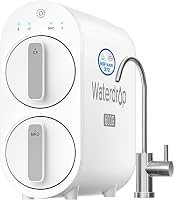
The smart faucet on models like the Waterdrop G3P600 shows the TDS level of the water it just filtered. See the full lineup in our guide to the best tankless reverse osmosis system.
How does water move through a tankless RO system step by step?
Water enters the pre-filter, gets pressurized by the pump, crosses the RO membrane, and flows to the faucet within seconds. Wastewater carrying the rejected solids drains away at the same time.
When you open the faucet, the flow sensor signals the pump. Feed water first hits the pre-filter stages, which remove larger particles and chlorine that would damage the membrane.
The pump raises pressure so water can pass through the semipermeable membrane, leaving dissolved salts, heavy metals and PFAS behind on the concentrate side.
The purified stream then runs through a final carbon stage for taste. The concentrate stream flushes to the drain.
Because the system filters only when you ask for water, nothing sits in a tank losing freshness. A 600-gallon-per-day unit like the G3P600 fills an 8 oz cup in about 8 seconds.
Why is there no storage tank, and what changes without one?
The pump and membrane replace the tank, filtering water the moment you turn the tap. You trade a reserve of pre-filtered water for fresh water every time and much more cabinet room.
A traditional RO system filters slowly into a pressurized tank, then the tank pushes water to the faucet. The tank is bulky and the water in it can sit for hours.
A tankless unit has no tank to refill, so the cabinet stays open for cleaning supplies or a trash can. Waterdrop says the G3P600 tankless design saves about 70% of under-sink space.
The catch is the pump. A tankless system needs an outlet nearby, while a tank system runs on line pressure.
You also wait a few seconds for the first water while the pump spins up. Many people find the short wait worth it for the space and freshness.
How does the RO membrane remove contaminants?
The membrane is a semipermeable sheet that lets water molecules pass but blocks larger dissolved particles. Pressure from the pump forces water across it, while salts, metals and PFAS stay on the waste side.
Reverse osmosis works against natural flow. Normally water moves from low to high concentration; the pump reverses that by applying pressure greater than the osmotic pressure.
Water molecules squeeze through the membrane's tiny pores, while larger ions and molecules are rejected and flushed away.
The pre-filters matter here. Chlorine in tap water degrades many RO membranes, so the carbon stage removes it first.
Waterdrop says the G3P600 uses 8 filtration stages and is certified to NSF/ANSI 58 for TDS reduction. SGS testing also covers reductions of chromium, fluoride, arsenic and radium.
Certification claims are worth checking against the model's listed standards before you buy.
How does the drain ratio affect water waste?
The drain ratio compares pure water produced to water sent down the drain, and a higher first number means less waste. Older RO systems wasted several gallons for every gallon made.
A tankless system continuously flushes concentrate while it filters, so the ratio is fixed by the design. Waterdrop G3P800 runs at a 3:1 pure to drain ratio, producing one cup of wastewater for every three cups of filtered water.
The G3P600 runs at 2:1, and the Waterdrop G2 runs at 1:1. That's a big improvement over old-style units that could waste 4 gallons for every gallon filtered.
The ratio only counts water used while filtering. Because a tankless system doesn't run continuously to refill a tank, it also avoids the periodic tank flushes that add hidden waste.
If water conservation matters where you live, compare the ratios across models. Our Waterdrop G3P800 vs X8 comparison breaks down how the two differ on waste and capacity.
Why does a tankless RO system need electricity?
The booster pump runs on household current, so the system needs a grounded outlet under the sink. That's the main installation difference from a tank-style RO unit.
Line pressure in most homes isn't enough to push water through an RO membrane at a useful rate. The pump supplies consistent pressure, which is why tankless units keep a steady flow instead of slowing as a tank empties.
A 400-gallon-per-day model like the Waterdrop G2 needs an outlet plus two drilled holes: one for the faucet and one for the drain line.
Plan the outlet before you buy. If your cabinet has no receptacle, an electrician may need to add one.
The upside is steady output: the pump doesn't fade as you fill a pitcher. The downside is that a power outage stops filtration until the power returns.
How do smart faucets and filter tracking work?
A sensor in the faucet or line detects when water flows, and a small display shows TDS and filter life. The electronics are what make a tankless system "smart".
The Waterdrop G3P600 comes with a smart display faucet. Its TDS monitor tells you the quality of the filtered water, and a filter life tracker shows how soon a cartridge needs replacing.
The G3P800 adds an LED ring that lights up when water flows. These readouts turn filter changes from guesswork into a countdown.
The faucet is also the control point. When you lift the handle, the flow sensor starts the pump.
When you close it, the pump stops. If the display warns about water quality or filter life, that's your cue to act.
Replace cartridges on schedule so the membrane keeps performing.
How do you install and maintain a tankless RO system?
Installation means mounting the unit, connecting feed and drain lines, drilling the faucet hole and plugging in the pump. Maintenance is mostly cartridge swaps.
Mount the system on the cabinet wall or floor with the brackets, then connect the feed line to the cold water supply. Run the drain line to the sink's drain pipe through the second hole.
Install the faucet through the first hole and connect its line. Turn on the water and let the system flush as the instructions direct.
Filter changes are quick on these models. The G3P600 uses twist-and-pull cartridges you rotate out in seconds without moving the system.
The G2 uses a similar twist-and-pull design. Follow the tracker on the faucet, and keep spare cartridges on hand so you don't skip a change.
A quick Waterdrop G3P600 review covers how the cartridge system works day to day.
What should you know before buying a tankless RO system?
Measure your cabinet first, then check the outlet, the drain ratio and the filter cost. A tankless unit saves space, but only if it fits and has power.
The G3P600 measures 18.12 by 5.67 by 17.72 inches, so the cabinet needs to be larger than that. Check the outlet location too; the pump's cord has to reach.
Compare GPD ratings against your household: 400 GPD suits a couple or small family, while 800 GPD handles a big family drawing water often. Higher capacity means faster fills and less waiting at the tap.
If you want minerals back in the water, look for a model with a remineralization stage. Our guide to the best tankless RO system with remineralization covers those options.
Otherwise, pick by cabinet fit and drain ratio first. The Waterdrop G3P800 offers the highest capacity and the best pure-to-drain ratio of the three.
How does a tankless RO system work in daily use?
In daily use, a tankless RO system works like a normal faucet with a short pause before the water arrives. You lift the handle, the pump starts, and filtered water flows within seconds.
Close the handle and it stops.
That's the whole answer to how a tankless RO system works: pump, membrane, faucet, no tank. The space saving and fresh water are the payoff, and the outlet and pump are the trade-offs.
Pick a model that fits your cabinet and your daily water volume. Measure first, check the outlet, then compare drain ratios so you know what you're getting before you order.
Frequently asked questions
Does a tankless RO system need a power outlet?
Yes. A tankless RO system uses an electric pump to push water through the membrane, so it needs an outlet under the sink.
A standard pressurized RO tank system runs on water line pressure alone, so plan for a nearby receptacle before you buy.
Can a tankless RO system fill a refrigerator or ice maker?
It can, but a fridge or ice maker usually needs steady pressure from a small pressure tank. Some makers sell that tank as an add-on.
Without one, the fridge line may only get water while the faucet is open.
How much wastewater does a tankless RO system make?
It depends on the model. Waterdrop G3P800 runs at a 3:1 pure to drain ratio, G3P600 at 2:1 and G2 at 1:1.
A higher first number means less wastewater per cup of filtered water.
Do tankless RO systems remove minerals from water?
Yes. The RO membrane removes most dissolved solids, including the calcium and magnesium that give water its taste.
If you want minerals back, look for a model with a remineralization stage or add a separate remineralization filter after the system.
How often do tankless RO filters need changing?
Follow the filter life tracker, which most smart faucets display. Life depends on how much water you use and your incoming water quality.
The twist-and-pull cartridges on these models change in seconds without moving the unit.
Why does a tankless RO system make noise?
The pump runs while you draw water, so you'll hear a soft hum when the faucet is open. Integrated housing on models like the Waterdrop G2 helps muffle it.
The noise stops when you close the tap.