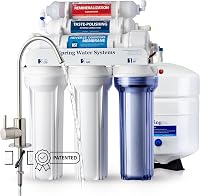
7 Best Tankless RO System Under Sink (November 2026)
The best tankless reverse osmosis systems under the sink include the iSpring RO5004F Reverse Osmosis Water Filter (best overall), the Frizzlife 1000GPD Reverse Osmosis Water Filter for mineral water, and the Waterdrop G2P600 for easy filter changes.
On this page (9 sections)
- The best tankless RO systems for tight cabinets
- How these tankless systems compare
- How we compared these systems
- What should you measure before buying a tankless RO system?
- Does a tankless RO system need a pump and an outlet?
- Which tankless RO is best for minerals and alkaline water?
- How much water does a tankless RO waste?
- Do tankless RO systems fit where a tank system won't?
- The verdict
The best tankless RO system under sink for most kitchens is the iSpring RO5004F, a 500 GPD unit with a built-in UV stage and a 6.1-inch-wide body that fits cabinets where a storage tank won't. Pick the Frizzlife 1000GPD if you want minerals added back, or the ANGEL X4 if water savings matter most.
If you'd rather keep a tank because your cabinet has room, our guide to the best under sink reverse osmosis system with a tank covers that path. This post is about making the tankless route fit.
Our picks at a glance
-
1

-
2
 Best for mineral water
Frizzlife 1000GPD Reverse Osmosis Water Filter
8.3/10 our score
See it on Amazon -
3
- 4
 Check it
ANGEL X4 Tankless Reverse Osmosis System
Best for water savings - 5
 Check it
VIOMI V6 PRO 600GPD Under-Sink Reverse Osmosis
Best for fridge hookups - 6
 Best for choosing your waterCheck it
- 7
 Best for smaller householdsCheck it
The best tankless RO systems for tight cabinets
Every system here is slim enough to sit beside a disposal, and each one suits a different habit. Start with the overall pick, then match the rest to your water, your space and how often you want to change filters.
iSpring RO5004F Reverse Osmosis Water Filter: Best overall
- 500 GPD capacity
- Built-in UV filter
- 2:1 pure-to-drain ratio
- 6.1 in wide body
A slim tankless unit with UV protection, SGS-tested PFAS and TDS reduction, and a pump that helps when household pressure runs low.
Pros
- Built-in UV light
- Pump for low pressure homes
- Leak-stop valve
- Filter life monitor
Cons
- Uses electricity
- Requires a nearby outlet
The iSpring RO5004F is the one to buy first. Its cabinet footprint is 15.2 by 6.1 inches, so it slides into the narrow slot beside most plumbing without pushing out the trash can.
The built-in UV light is the feature no other pick here has. It runs for up to 8,000 working hours with its own status indicator, which adds a layer after the 0.0001-micron RO membrane.
iSpring says SGS testing backs its PFAS and TDS reduction claims, and the brand says the unit removes over 99% of 1,000+ contaminants. A 500 GPD membrane fills a cup in about 10 seconds, and the 2:1 ratio keeps waste reasonable.
The pump helps in homes with weak pressure, and a leak-stop valve shuts the system down if water escapes. Filter changes use a twist-to-release design with a life indicator.
Trade-off: it costs more than the Frizzlife 600GPD and needs a power outlet. For a first tankless system in a normal kitchen, it's the safest buy here.
Frizzlife 1000GPD Reverse Osmosis Water Filter: Best for mineral water
- 1000 GPD capacity
- Alkaline remineralizing stage
- Real-time TDS display
- 2:1 pure-to-drain ratio
A high-output tankless RO with a post filter that raises pH above 7.5 and adds back minerals, plus a smart panel that shows TDS as you pour.
Pros
- 0.7 GPM flow rate
- Alkaline mineral stage
- Live TDS readout
- Smart filter-life panel
Cons
- Wider than the iSpring
- Alkaline stage adds a filter to replace
Frizzlife's PD1000-TAM4 suits a household that misses the taste of mineral water. The post filter lifts pH above 7.5 and puts back minerals the RO membrane strips out, so the glass tastes rounder than plain RO.
Its 1000 GPD membrane and 0.7 GPM flow are the fastest on this list. Frizzlife says a cup fills in about 3 seconds, which matters when you're cooking and refilling a pot.
The smart panel shows live TDS and remaining life for each cartridge, so you can see when the water quality shifts. At 5.28 inches wide, it's one of the slimmest systems here.
It's 17.4 inches long, though, so measure depth as well as width. Frizzlife lists an operating pressure range of 20 to 80 psi, which means a home with very high pressure should plan for a regulator.
The system is certified against NSF/ANSI 58, 53, 42 and 372, and Frizzlife says SGS testing covers 1,000+ contaminants, including PFAS and lead. The brushed nickel faucet is included, so the kit covers the whole install.
Trade-off: the alkaline stage adds one more filter to replace each year. Choose it over the iSpring if minerals matter more than UV.
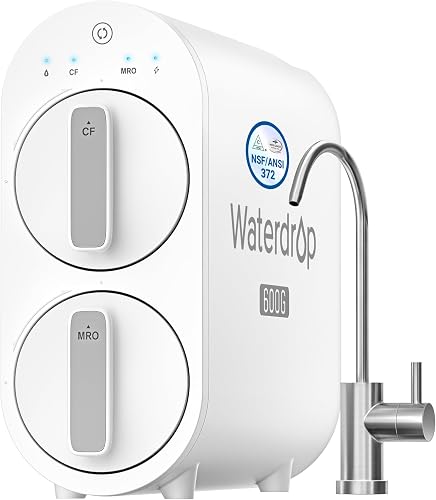
Waterdrop G2P600: Best for easy filter changes
- 600 GPD capacity
- 7-stage filtration
- 2:1 pure-to-drain ratio
- Twist-and-pull filters
A tankless 600 GPD unit that fills a 200 ml cup in about 8 seconds, with filters that swap out without tools or moving the system.
Pros
- Tool-free filter changes
- 600 GPD flow
- Filter life indicators
- NSF/ANSI 372 certified
Cons
- No UV stage
- Needs a power outlet
The Waterdrop G2P600 suits someone who wants filter changes to take seconds. Its cartridges twist and pull out without tools, and the system stays where it's mounted.
That matters in a cabinet where you can't easily reach behind the unit. Filter life indicators warn you before the change is due, and the 7-stage setup is certified to NSF/ANSI 372 for lead-free materials.
Waterdrop rates the flow at 600 GPD, enough to fill a 200 ml cup in about 8 seconds. The 2:1 drain ratio means 1 cup of waste for every 2 cups of clean water, and Waterdrop says the design saves 60% more water than traditional RO purifiers.
The waste water can go on mopping or laundry.
At 14 inches tall, its height is easy to work with, which helps under a shallow sink base. It's 17.3 inches long and 5.9 inches wide, so the length is the dimension to check against your cabinet depth.
The system supports water up to 500 ppm TDS, which covers most municipal supplies. Waterdrop rates installation at about 30 minutes for a DIYer and includes the faucet and filters in the box.
Trade-off: there's no UV stage, and it needs an outlet. Compared with the iSpring, you give up the extra light stage for a lower, easier-to-service box.
ANGEL X4 Tankless Reverse Osmosis System: Best for water savings
- 1000 GPD capacity
- 3:1 pure-to-drain ratio
- Smart faucet with TDS display
- 5.74 in wide body
A slim 1000 GPD system that sends only 1 cup to drain for every 3 cups purified, with TDS and filter status shown on the faucet itself.
Pros
- 3:1 pure-to-drain ratio
- Faucet-mounted TDS display
- 12-month CFIII, 3-year RO filter
- Fills an 8 oz glass in about 5 seconds
Cons
- Needs a faucet hole and outlet
- Upper pressure limit of 116 psi
The ANGEL X4 is the pick when water bills or drought rules push you toward efficiency. Its 3:1 pure-to-drain ratio sends about 33% less water to the drain than a 2:1 system for the same output.
A 1000 GPD membrane pours 0.66 GPM, filling an 8 oz glass in about 5 seconds. The faucet itself shows real-time TDS and the status of the CFIII and RO filters, so you check quality at the sink instead of opening the cabinet.
Filter life is long: ANGEL rates the CFIII at up to 12 months and the RO membrane at up to 3 years. Replacements press out with a button, and the body is 5.74 inches wide, leaving room for plumbing and a disposal beside it.
ANGEL says the system is certified to NSF/ANSI 372, 58 and 42, and claims 98.9% PFAS reduction along with 99.6% for lead and fluoride. It supports source water up to 1,000 ppm TDS, a wide range for a tankless unit.
Trade-off: it needs a faucet hole, a drain saddle and an outlet, and the operating range tops out at 116 psi. If your pressure runs higher, add a regulator.
VIOMI V6 PRO 600GPD Under-Sink Reverse Osmosis: Best for fridge hookups
- 600 GPD capacity
- 9-stage filtration
- 3:1 pure-to-drain ratio
- App control and LED faucet
A compact 600 GPD tankless system that can run a line to a refrigerator or ice maker, with real-time TDS on the faucet and deeper tracking in an app.
Pros
- Fridge and ice maker compatible
- 9-stage filtration
- TDS and filter life in the app
- 3:1 drain ratio
Cons
- Needs its own outlet away from a switched disposal outlet
- Uses two drilled holes
The VIOMI V6 PRO solves a problem the others leave open: filling a fridge or ice maker. Standard tubing runs a second line to the appliance, so the same system feeds your glass and your freezer.
The tubing itself isn't included, so plan for that.
At 5 inches wide and 12.8 inches tall, it's the slimmest and shortest body on this list. It needs a dedicated outlet that can't be the switched outlet for a disposal.
VIOMI is explicit about that, because the pump would lose power whenever the disposal switch is off.
The 9-stage filtration is certified to NSF/ANSI 42, 53 and 58, with SGS testing behind its PFAS, lead and arsenic claims. The LED faucet shows TDS and filter life, and the app tracks consumption and system health.
The pre-installed RO filter is rated for 2 years and the PCB for 1 year.
The 600 GPD membrane fills an 8 oz glass in about 9 seconds, and the 3:1 ratio matches the ANGEL for efficiency. The faucet needs a 1-inch to 1.5-inch hole plus a 1/4-inch drain hole.
Trade-off: it needs two drilled holes and its own outlet. Choose it when fridge water is the goal, not just the tap.
Waterdrop WD-T4-A: Best for choosing your water
- 450 GPD capacity
- 10-stage filtration
- Dual flow: plain RO or alkaline
- 2:1 pure-to-drain ratio
A tankless RO with two streams: plain purified water for cooking and an alkaline, mineral-enriched line for drinking, switched at the faucet.
Pros
- Two water streams from one unit
- Alkaline mineral stage
- Buzzer and light filter alerts
- NSF/ANSI 372 certified
Cons
- Lowest flow of the tankless units here
- Faucet needs a drilled hole
The Waterdrop WD-T4-A is for the household that wants two kinds of water from one faucet. Turn one way for plain RO water for coffee and cooking, the other for an alkaline, mineral-enriched stream for drinking.
Its 10-stage filtration covers PFOA, PFOS and heavy metals, then the mineral line adds the alkaline step. Both streams come out of the same dual-LED faucet, so you see the state of the system as you pour.
The 450 GPD membrane is the lowest flow among the tankless units here, which fits a couple or a small family. The 2:1 ratio keeps waste in line with the iSpring and Frizzlife.
Waterdrop says the ratio reduces wastewater by up to 800% against older systems.
Filter alerts use lights and a buzzer, and the intervals are set: CF at 6 months, RO at 24 months, CB and alkaline at 12. The tankless body frees about 70% more under-sink space than a tank model, and the faucet requires a drilled hole.
The unit needs a power connection and includes three pre-installed filters plus the faucet and manual.
Trade-off: less output than the 600 and 1000 GPD units, and the faucet needs a drilled hole. Pick it if the choice between plain and alkaline water is worth the slower flow.
Frizzlife 600GPD Alkaline RO: Best for smaller households
- 600 GPD capacity
- Alkaline remineralizing stage
- 2:1 pure-to-drain ratio
- Smart TDS display
A lower-cost tankless RO with a mineral stage that lifts pH above 7.5, a TDS panel and a 600 GPD membrane for couples and small families.
Pros
- Alkaline post filter
- Real-time TDS display
- Compact footprint
- Slower output suits lighter use
Cons
- The iSpring RO5004F pours slower
- Alkaline filter adds a yearly change
The Frizzlife PD600-TAM3 is the budget-friendly way into a mineral-adding tankless RO. It's the smaller sibling of the 1000 GPD model, with a 600 GPD membrane and the same idea of lifting pH above 7.5.
A 0.41 GPM flow fills a 330 ml cup in about 10 seconds. That's fine for two people, and slower than the bigger Frizzlife when a family queues up at dinner.
The smart display shows outgoing TDS and the life left in each filter, and the TAM3 alkaline stage restores minerals. At 5.3 inches wide and 14.7 inches long, it tucks into a small cabinet.
It runs on corded power, like the other tankless units.
Frizzlife says the system is certified against NSF/ANSI 58, 53, 42 and 372 and reduces PFAS and PFOA. The kit includes the CP filter, 600 GPD RO membrane, TAM3 alkaline filter and a brushed nickel faucet.
Its upper temperature rating is 100 °F, so feed it cold water only.
Trade-off: the iSpring RO5004F pours slower still. If three or more people draw water at once, spend more on the iSpring or the 1000 GPD Frizzlife.
How these tankless systems compare
The table below lines up the numbers that decide most purchases: output, waste ratio, cabinet width and what each system adds beyond the membrane.
| Product | Best for | Capacity | Size (L x W x H) | Drain ratio | Our score |
|---|---|---|---|---|---|
| iSpring RO5004F Reverse Osmosis Water Filter | overall | 500 GPD | 15.2 x 6.1 x 16.6 in | 2:1 | 8.6 |
| Frizzlife 1000GPD Reverse Osmosis Water Filter | mineral water | 1000 GPD | 17.4 x 5.28 x 15.51 in | 2:1 | 8.3 |
| Waterdrop G2P600 | easy filter changes | 600 GPD | 17.3 x 5.9 x 14 in | 2:1 | 8.2 |
| ANGEL X4 Tankless Reverse Osmosis System | water savings | 1000 GPD | 17.55 x 5.74 x 15.27 in | 3:1 | 8.1 |
| VIOMI V6 PRO 600GPD Under-Sink Reverse Osmosis | fridge hookups | 600 GPD | 16.3 x 5 x 12.8 in | 3:1 | 8.0 |
| Waterdrop WD-T4-A | choosing your water | 450 GPD | 16.54 x 6.22 x 17.95 in | 2:1 | 7.8 |
| Frizzlife 600GPD Alkaline RO | smaller households | 600 GPD | 14.7 x 5.3 x 15.5 in | 2:1 | 7.5 |
Width is the first filter. Anything under about 6.5 inches fits the space a tank used to take, and every pick here clears that bar.
Depth and height matter next, because a tall body can foul a shallow sink base or a drawer above. The tallest unit here is the WD-T4-A at 17.95 inches, and the shortest is the VIOMI V6 PRO at 12.8 inches.
Flow rate follows your household size. A 450 to 600 GPD system serves one to three people well.
A 1000 GPD unit is the answer for a busy kitchen where cups, bottles and pots get filled back to back. The published flow rates run from 0.35 GPM on the iSpring RO5004F to 0.7 GPM on the Frizzlife 1000.
Then look at extras. UV, alkaline remineralizing and fridge lines are the three add-ons in this group, and no single unit here has all three.
The drain ratio decides long-term water use, with 3:1 beating 2:1. Filtration certification is the quiet decider: some units carry full-system NSF/ANSI 58, others only material safety under 372.
Which extras matter for your kitchen?
A UV stage helps if your source water carries bacteria risk and you want a second barrier after the membrane. Only the iSpring RO5004F here adds it, with a bulb rated at 8,000 hours.
An alkaline stage matters if you dislike the flat taste of plain RO water. A fridge line matters if you want filtered ice without a second appliance, and only the VIOMI V6 PRO advertises that hookup.
How do filter costs and intervals differ?
Intervals vary more than the brands' marketing suggests. iSpring sells 1-year and 2-year filter packs for the RO5004F, so you can buy a year or more of filters in one order. The Frizzlife pair adds a yearly alkaline filter on top of the membrane and carbon stages.
The ANGEL X4 and VIOMI stretch the RO membrane to 3 years, though the carbon filters still change yearly or sooner. A 9-stage or 10-stage system has more filters to buy than a 7-stage one, even when the headline interval looks similar.
How we compared these systems
We scored each system on the specs that change daily use: cabinet size, output, drain ratio, filter life, certifications and the extras each brand builds in. We checked the numbers each brand publishes, including GPD ratings, flow rates, dimensions and NSF listings.
Where a brand gives its own test results, such as SGS PFAS reduction, we treated it as the brand's claim.
The score weighs specs, features and how well the system fits the under-sink search, not a test performed by our team. A 9+ would need a combination of size, output and extras no unit in this group offers.
Systems with full-system certification scored higher than those listing only material safety, and units needing two drilled holes lost a little against single-hole designs.
What should you measure before buying a tankless RO system?
Measure the cabinet width, depth and height at the point where the unit will sit, then add 2 inches of clearance around it for tubing and airflow. Check for an outlet within reach of the power cord.
You also need room for the feed-water adapter on the cold line and the drain saddle connection. The VIOMI asks for a 1-inch to 1.5-inch faucet hole and a separate 1/4-inch drain hole, so the countertop needs to allow both.
Height is the sneaky one. The tallest pick here is 17.95 inches, and a shallow sink base with a fixed shelf won't take that.
Measure from the cabinet floor to the lowest obstruction, not to the countertop.
Finally, find the outlet. A switched outlet wired to a disposal won't keep the pump running, so plan a separate receptacle if yours is shared.
The VIOMI manual spells this out, and the same logic applies to every pump-driven unit here.
Does a tankless RO system need a pump and an outlet?
Yes, every system in this roundup uses a booster pump, so each one needs a standard outlet under the sink. The pump is what lets a tankless unit push water at pressure without a storage tank.
Unlike the tank-based iSpring RCC7AK-BN in our tank roundup, which runs on line pressure alone, these units all draw power.
The pump also helps in homes with low water pressure. The iSpring RO5004F's pump addresses low pressure and keeps the membrane working efficiently, and it runs quietly.
Higher pressure isn't always better. The ANGEL X4 lists an operating range of 58 to 116 psi, so a home near the top should add a pressure regulator.
The Frizzlife 1000GPD lists 20 to 80 psi. Check your home's pressure with a gauge before installing.
What happens during a power outage?
A tankless system stops producing water when the power goes out, because the pump can't run. A tank model keeps a reserve in its pressure tank that can pour a few glasses without power.
If outages are common in your area, that reserve is a real argument for the tank route. Otherwise, the outage just means waiting until the power returns.
Which tankless RO is best for minerals and alkaline water?
Pick the Frizzlife 1000GPD if minerals are your reason for buying, or the Waterdrop WD-T4-A if you want a switch between plain and alkaline streams. Both raise pH and add minerals back after the RO membrane.
The Frizzlife pair puts the alkaline stage in the filter stack, while the WD-T4-A sends it down a separate faucet line. The Frizzlife PD600-TAM3 does the same job at a lower output and a lower cost.
If you want a wider look at mineral-adding systems, our roundup of the best alkaline reverse osmosis system covers the options in more detail, including tank models.
Plain RO water is slightly acidic because the membrane strips minerals along with contaminants. A remineralizing stage fixes the taste and the pH, at the cost of one more filter to change each year.
Frizzlife targets pH above 7.5 on both of its alkaline units. If you mostly use filtered water for coffee, tea or cooking, the difference shows up in the cup too.
How much water does a tankless RO waste?
A tankless RO sends a set share of water to the drain, and the ratio tells you how much. A 2:1 system wastes 1 cup per 2 cups purified; a 3:1 system wastes 1 cup per 3 cups.
The gap adds up. The ANGEL X4 and VIOMI V6 PRO send about 33% less water to drain than the 2:1 units for the same output, which is why they lead on efficiency here.
VIOMI puts the saving at 75% efficiency, against traditional systems that waste up to 3 gallons for every gallon purified. The Waterdrop G2P600, iSpring RO5004F, both Frizzlife units and the WD-T4-A all run at 2:1, still far better than older systems that wasted several cups per cup made.
If you pay for water or live where restrictions apply, the 3:1 units earn their place. Otherwise the difference is modest, and flow, size or extras should decide.
On a 2:1 system the drain line still needs a place to go, so the drain saddle connection matters as much as the ratio.
Can you reuse the waste water?
Yes, on most systems the drain water is fine for mopping floors, washing a car or flushing a toilet. Waterdrop suggests those uses for the G2P600's waste stream.
Don't drink it and don't water edible plants with it if you're unsure what the membrane rejected.
Do tankless RO systems fit where a tank system won't?
Yes, that's the main reason to choose one. Dropping the pressure tank frees the widest part of a traditional system's footprint, and the tankless bodies here are 5 to 6.2 inches wide.
That's why a disposal and a trash can can both fit where a tank once sat.
The trade is a power cord and a pump. A tank system runs on line pressure alone and needs no outlet, which is why some kitchens still choose it.
If your cabinet has room for a tank and no outlet, the tank route is simpler. The iSpring RCC7AK-BN in our tank guide is the example, with its top-mounted faucet fastener and no power requirement.
For a full walkthrough of both designs, read our plain buyer's guide to under sink reverse osmosis systems. If your cabinet is the tight part, our roundup of the best tankless reverse osmosis system for tight cabinets goes deeper on fit and installation.
The verdict
The best tankless RO system under sink for most kitchens is the iSpring RO5004F, because it pairs a slim 6.1-inch body with UV protection, a low-pressure pump and a 2:1 drain ratio at a fair output. The built-in UV stage is the tiebreaker over the faster units, and the leak-stop valve adds peace of mind for a first install.
Choose the Frizzlife 1000GPD if you want alkaline, mineral-rich water at the fastest pour here. Choose the ANGEL X4 or VIOMI V6 PRO if water savings lead your list, and the VIOMI if a fridge line matters.
The Waterdrop G2P600 is the easiest to service, and the WD-T4-A is the one to pick when you want both plain and alkaline water from one faucet. For a smaller household on a tighter budget, the Frizzlife 600GPD is the sensible entry.
Whichever you pick, measure the cabinet and find the outlet first.
Our top 3 picks at a glance
-
1
-
2
Best for mineral water
Frizzlife 1000GPD Reverse Osmosis Water Filter
8.3/10 our score
See it on Amazon -
3
Frequently asked questions
How much space does a tankless RO system save?
It removes the storage tank, which is the widest part of a traditional system. The tankless bodies here run about 5 to 6.2 inches wide.
That opens room for a disposal, cleaning supplies or a trash can where the tank used to sit.
What does the pure-to-drain ratio mean?
It tells you how much purified water you get for each cup sent down the drain. A 2:1 system makes 2 cups of clean water per cup of waste.
The ANGEL X4 and VIOMI V6 PRO reach 3:1, which saves more water over a year.
Can a tankless RO system feed a refrigerator?
Some can. VIOMI says the V6 PRO can supply a fridge or ice maker through a separate line with standard tubing.
For other models, add an ice maker kit if the brand offers one, and check that the line reaches your fridge before installing.
How often do tankless RO filters need changing?
It varies by model. The ANGEL X4 rates its CFIII filter at up to 12 months and its RO membrane at up to 3 years. iSpring sells 1-year and 2-year filter packs for the RO5004F.
Follow the system's own indicator lights rather than a fixed calendar.