8 Best Tankless RO System With Remineralization (November 2026)
The best tankless RO systems with remineralization include the Waterdrop G5P500A for small kitchens that want minerals, the Waterdrop G3P600 for fast flow from a slim cabinet, and the iSpring RCC7AK-BN for balanced everyday drinking water.
On this page (8 sections)
- The best tankless RO systems with remineralization for different kitchens
- How these tankless RO systems with remineralization were compared
- Which tankless RO systems with remineralization fit a small cabinet?
- Do you need the remineralization stage at all?
- How much flow do you need from a remineralizing RO system?
- What should you know before installing a remineralizing tankless RO system?
- How often do remineralizing filters need replacing?
- Which tankless RO system with remineralization should you buy?
The best tankless RO system with remineralization for most kitchens is the Waterdrop G5P500A, because it packs an eight-stage setup with an alkaline mineral stage into a 13.9 in tall tankless body. Pick the Frizzlife 1000GPD when your household fills pitchers all day, or the Waterdrop WD-T4-A when people at home want both plain and mineral water.
A tankless system saves cabinet space, but every tankless pick here needs an outlet. Only the iSpring RCC7AK-BN runs without power, and it brings a storage tank back into the cabinet.
If your cabinet is unusually tight, our guide to the best tankless reverse osmosis system covers slim bodies in more depth. For a full read on the Waterdrop unit, the Waterdrop G3P600 review goes through its daily use.
Our picks at a glance
-
1

-
2

-
3
- 4
 Check it
Frizzlife 1000GPD Reverse Osmosis Water Filter
Best for big households and busy taps - 5
 Best for iSpring owners stepping up to tanklessCheck it
- 6
 Best for households that want a plain water optionCheck it
- 7
 Best for a lower flow on a smaller budgetCheck it
- 8
 Best for a smart faucet and mineral water togetherCheck it
The best tankless RO systems with remineralization for different kitchens
The top score goes to the iSpring because it balances a certified body and a real mineral stage with zero power draw. The tankless picks win on cabinet fit, flow and faucet features, so match the unit to how your household actually drinks water.
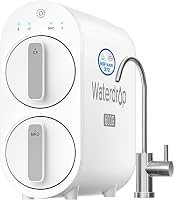
Waterdrop G5P500A: Best for small kitchens that want minerals
- 500 GPD, eight-stage filtration
- Alkaline mineralization with Ca, Mg, Na and K
- 2:1 pure-to-drain ratio
- Compact tankless body
- NSF/ANSI 58 and 372 certified
The shortest body in this group, with a real alkaline stage that adds calcium, magnesium, sodium and potassium. A strong fit where cabinet height is the limit.
Pros
- Alkaline mineral stage
- Shortest height here at 13.9 in
- 500 GPD flow
- 2:1 pure-to-drain ratio
Cons
- Lower capacity than the G3P600
- Mechanical faucet, not a smart display
- Needs under-sink power
The Waterdrop G5P500A suits a small kitchen that still wants minerals in the water. Its eight-stage filtration ends in an alkaline stage that adds Ca²⁺, Mg²⁺, Na⁺ and K⁺, and the body is 13.9 in tall, the shortest here.
The 500 GPD flow fills a 6 oz cup in about 8 seconds, so the smaller capacity doesn't feel slow at the tap. A 2:1 pure-to-drain ratio keeps wastewater low, and the tankless body frees up cabinet space.
Its 16.69 in length and 5.69 in width keep the footprint modest too.
Waterdrop's XT kit lets you run the G5P500A to a fridge or ice maker, which suits a household that wants mineral water in more than one place. The mechanical faucet is the trade-off against the smart faucets on the G3P600 and X8-WAN.
Choose it when cabinet height is the hard limit. Skip it if you need the fastest flow for pitchers and pots.
Waterdrop G3P600: Best for fast flow from a slim cabinet
- 600 GPD, eight-stage filtration
- 2:1 pure-to-drain ratio
- Smart display faucet with TDS monitor
- Saves about 70% under-sink space
- NSF/ANSI 58 and 372 certified
A slim, pump-driven unit that fills a cup in about 8 seconds. The smart faucet shows TDS and filter life, but the G3P600 itself has no mineral stage.
Pros
- 600 GPD flow
- Smart faucet with TDS readout
- 2:1 pure-to-drain ratio
- Slim 5.67 in width
Cons
- No remineralization stage
- Needs under-sink power
- Requires drilling for the faucet
The Waterdrop G3P600 suits a busy kitchen with a narrow cabinet and a free outlet. Its 600 GPD membrane fills an 8 oz cup in about 8 seconds, and the 2:1 pure-to-drain ratio sends just one cup of waste for every two cups of filtered water.
The smart display faucet shows TDS and filter life, so you can watch water quality without opening the cabinet. Filters twist out in seconds, and the tankless body saves about 70% of under-sink space compared with a tank model.
The body is 18.12 in long but only 5.67 in wide, so it slides in beside a disposal.
The catch for this roundup is simple: the G3P600 filters but does not remineralize. Its eight stages stop at pure water.
If you want minerals in the glass, the G5P500A or the Frizzlife units do that job. The G3P600 wins when speed and a smart faucet matter more than mineral content.
Choose it for fast, monitored filtration in a slim cabinet. Skip it if remineralization is the reason you're shopping.
Our Waterdrop G3P800 vs X8 comparison helps if you're weighing bigger Waterdrop units.
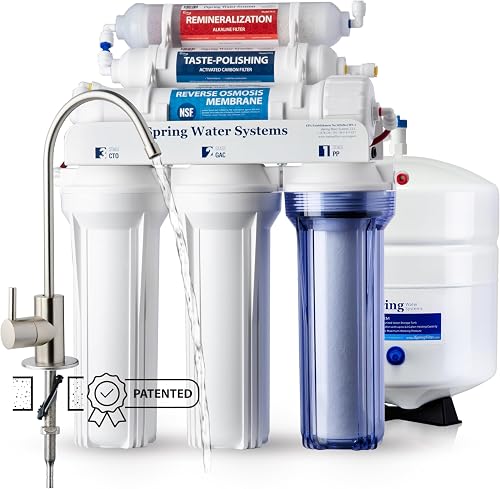
iSpring RCC7AK-BN: Best for balanced everyday drinking water
- 75 GPD, six-stage filtration
- Natural mineral AK stage for pH and minerals
- NSF/ANSI 58 certified system
- Transparent first-stage housing
- No electricity needed
A tank-based workhorse with a real remineralization stage, a certified body and no power draw. Best when you want mineral water without a pump or a smart faucet.
Pros
- NSF/ANSI 58 system certification
- Natural mineral AK stage
- Works without electricity
- Transparent sediment housing
Cons
- Slower 75 GPD flow than the tankless picks here
- Storage tank takes cabinet space
- No smart display faucet
The iSpring RCC7AK-BN suits a kitchen where the cabinet can spare a tank and the outlet is already in use. Its patent-pending natural mineral AK stage delivers spring-style water with a balanced pH and multiple essential minerals, and the transparent first-stage housing lets you see when the sediment filter needs changing.
iSpring says the system reduces TDS by 93–98%, lead by over 98.9% and fluoride by over 97.4%, and the whole unit is certified to NSF/ANSI 58. The top-mounted fastener means you tighten the faucet from above the counter, so you don't crawl under the sink to finish the job.
The 75 GPD flow is the slowest here. A full glass comes from the storage tank, so you aren't waiting on the membrane at the tap.
That tank also means the water can sit between draws, and the tank needs its own corner of the cabinet. The unit runs on line pressure alone, which is why it has no pump to plug in.
If you want mineral water without an outlet, this is the one.
Choose it if you want mineral water without a power run. Skip it if cabinet space or fast continuous flow matters more.
Frizzlife 1000GPD Reverse Osmosis Water Filter: Best for big households and busy taps
- 1000 GPD, nine-stage filtration
- TAM4 alkaline post filter, pH above 7.5
- 2:1 pure-to-drain ratio
- Smart panel with real-time TDS
- Tankless design
The highest flow rate in this roundup, with an alkaline stage that targets pH above 7.5. Built for families that fill pitchers and cooking pots all day.
Pros
- 1000 GPD flow
- Alkaline TAM4 post filter
- Real-time TDS panel
- 2:1 pure-to-drain ratio
Cons
- Highest flow needs more drain capacity to match
- Needs under-sink power
- Faucet drilling required
The Frizzlife 1000GPD suits a large family or a home office kitchen where the tap runs all day. It produces up to 1000 gallons per day at a tested 0.7 GPM, which Frizzlife says fills a cup in about 3 seconds.
The nine-stage filtration ends in a TAM4 alkaline post filter that lifts pH above 7.5 and restores essential minerals. A smart panel shows real-time TDS and the remaining life of each cartridge, so filter changes aren't a guess.
Frizzlife tests the unit against NSF/ANSI 5, 42 and 53 and certifies it to NSF/ANSI 372 for lead-free material.
Its 2:1 pure-to-drain ratio matches the rest of this group. The tankless body also removes the pressure tank, which Frizzlife says avoids secondary contamination and saves about 70% of cabinet space.
At 5.28 in wide it is one of the slimmest bodies here. The single-twist cartridges make changes quick.
The trade-off against the 600 GPD Frizzlife is more capacity and one extra stage, at a larger footprint.
Choose it for the highest output in this roundup. Skip it if a 500 or 600 GPD unit already covers your daily use and you'd rather save cabinet room for the shorter bodies.
iSpring RO500AK: Best for iSpring owners stepping up to tankless
- 500 GPD, tankless design
- Alkaline remineralization stage
- NSF/ANSI 58 system certification
- Auto-flush after 24 hours idle
- Front-panel filter alerts
The tankless version of the iSpring formula, with an alkaline stage and a certified body. Fills an 8 oz cup in about 10 seconds.
Pros
- Alkaline remineralization stage
- NSF/ANSI 58 certified system
- Auto-flush cycle
- Filter reminder lights
Cons
- 0.4 GPM flow is slower than the Frizzlife 1000GPD
- Needs under-sink power
- Higher price tier than the RCC7AK-BN
The iSpring RO500AK suits someone who trusts the iSpring name and wants to move from a tank model to a tankless one. It's certified to NSF/ANSI 58 as a complete system, and the alkaline stage adds minerals and supports a balanced pH.
Flow reaches 0.4 GPM, which iSpring says fills an 8 oz cup in about 10 seconds. An auto-flush cycle runs after 24 hours of non-use to protect the membrane, and front-panel lights plus a buzzer tell you when filters are due.
The body is 16.13 in long and 5.13 in wide, so it's a close fit for narrow cabinets.
The trade-off against the RCC7AK-BN is power. The RO500AK needs an outlet, while the older iSpring runs without one.
Against the Frizzlife 1000GPD, its flow is slower. Against the G5P500A, its body is taller.
Choose it if you want a certified tankless unit with minerals from a brand with a long support history. Skip it if you can't spare an outlet or want the fastest tap.
Waterdrop WD-T4-A: Best for households that want a plain water option
- 450 GPD, ten-stage filtration
- Dual flow: standard RO and alkaline streams
- 2:1 pure-to-drain ratio
- Tankless design
- NSF/ANSI 372 certified
The only pick here that pours both plain RO water and mineral water from the same faucet. A good match for mixed households.
Pros
- Dual flow faucet with two water types
- Ten-stage filtration
- Filter change alerts
- 2:1 pure-to-drain ratio
Cons
- Slowest tankless unit here at 450 GPD
- Faucet drilling required
- Needs under-sink power
The Waterdrop WD-T4-A suits a household split between people who want minerals and people who prefer plain filtered water. Its dual-flow faucet pours a standard RO stream or a mineral-enhanced alkaline stream, and you switch between them at the tap.
Ten stages of filtration handle PFOA, PFOS, chlorine, heavy metals and sediment before the mineral line adds alkaline minerals. The 2:1 pure-to-drain ratio keeps waste low, and indicator lights with a buzzer remind you when a cartridge is due.
The filter schedule covers CF at 6 months, CB and the mineralizer at 12 months, and the RO membrane at 24 months.
At 450 GPD, this is the slowest tankless unit here. It also needs an outlet and a drilled faucet hole.
If everyone in the house wants minerals, the single-stream picks here are simpler. The dual LED faucet is the feature you're paying for.
Choose it for mixed preferences under one faucet. Skip it if you want maximum flow or the simplest possible plumbing.
Frizzlife 600GPD Alkaline RO: Best for a lower flow on a smaller budget
- 600 GPD, tankless design
- TAM3 alkaline post filter, pH above 7.5
- 2:1 pure-to-drain ratio
- Smart LED display with TDS
- Compact body
A smaller sibling to the Frizzlife 1000GPD with the same alkaline idea at a gentler flow. Suits a couple or a small family.
Pros
- Alkaline remineralization
- Compact 14.7 in body
- Smart TDS display
- 2:1 pure-to-drain ratio
Cons
- 600 GPD is less than the Frizzlife 1000GPD
- Needs under-sink power
- Fewer stages than the larger Frizzlife
The Frizzlife 600GPD Alkaline RO suits a couple or a small family that wants mineral water without paying for capacity it won't use. The TAM3 alkaline stage adjusts pH above 7.5 and restores essential minerals, and the body is a compact 14.7 in long.
Flow reaches 600 GPD, enough for a 330 ml cup in about 10 seconds according to Frizzlife. The smart LED display shows real-time TDS and the remaining life of each filter, and the tankless design removes the pressure tank.
At 5.3 in wide it fits beside most plumbing.
Against the Frizzlife 1000GPD, this unit gives up flow and stages. Against the iSpring RCC7AK-BN, it needs power.
It's the middle option for a smaller household that still wants minerals and a smart panel. Its faucet is brushed nickel stainless steel, and the cartridge set is CP, 600G RO membrane and TAM3.
Choose it for a compact, mineral-making unit on a smaller water budget. Skip it if you regularly fill large pots or pitchers back to back.
Waterdrop X8-WAN: Best for a smart faucet and mineral water together
- 800 GPD, ten-stage filtration
- Alkaline mineralization with Ca, Mg, Na and K
- Smart digital faucet with TDS and filter life
- 2:1 pure-to-drain ratio
- NSF/ANSI 42, 58 and 372 certified
Pairs a mineral stage with a smart faucet that shows TDS and filter life. The widest tankless body here, so measure before you buy.
Pros
- Smart digital faucet
- Alkaline mineral stage
- 800 GPD flow
- NSF/ANSI 42, 58 and 372 certified
Cons
- Widest tankless body here at 6.25 in
- Faucet drilling required
- Needs under-sink power
The Waterdrop X8-WAN suits someone who wants a smart faucet and a mineral stage in one unit. Its ten-stage filtration ends in an alkaline step that adds calcium, magnesium, sodium and potassium, and the digital faucet shows TDS and filter life.
The 800 GPD membrane gives fast flow for a family kitchen, and the 2:1 pure-to-drain ratio keeps wastewater in line with the rest of the group. Waterdrop says the tankless body installs in about 30 minutes with a basic DIY setup.
It's certified to NSF/ANSI 42, 58 and 372.
The trade-off is size. At 6.25 in wide and 18.2 in long, this is the widest tankless body here, so measure your cabinet before ordering.
It also needs an outlet and a drilled faucet hole. The RO membrane is rated for 24 months, which cuts how often you buy replacements.
Against the G5P500A, the X8-WAN adds the smart faucet and more flow but takes more cabinet room.
Choose it for smart-faucet convenience plus minerals. Skip it if your cabinet is narrow or you want the lowest flow and simplest install.
How these tankless RO systems with remineralization were compared
We ranked these units on five things: whether they actually add minerals, how much water they make per day, how much cabinet space they take, what they need from the install, and how well their certifications and filter costs hold up.
The mineral stage came first. A system without one, like the Waterdrop G3P600, still earns a high score for speed and monitoring but loses ground when remineralization is the whole reason you're shopping.
Flow rate shaped the rest. A 1000 GPD unit suits a busy family, while a 450 GPD unit covers a smaller household.
We also weighed tankless space savings against the one tank model here, which needs more cabinet room but no outlet. Certifications counted too, since a full NSF/ANSI 58 system rating covers the whole unit rather than one part.
Our score weighs specs, features and buyer feedback against what you're shopping for.
| Product | Best for | Capacity | Stages | Power | Our score |
|---|---|---|---|---|---|
| Waterdrop G5P500A | small kitchens that want minerals | 500 GPD | 8 | Corded electric | 8.6 |
| Waterdrop G3P600 | fast flow from a slim cabinet | 600 GPD | 8 | Corded electric | 8.8 |
| iSpring RCC7AK-BN | balanced everyday drinking water | 75 GPD | 6 | None needed | 9.1 |
| Frizzlife 1000GPD Reverse Osmosis Water Filter | big households and busy taps | 1000 GPD | 9 | Corded electric | 8.3 |
| iSpring RO500AK | iSpring owners stepping up to tankless | 500 GPD | Remineralizing RO | Corded electric | 7.9 |
| Waterdrop WD-T4-A | households that want a plain water option | 450 GPD | 10 | Corded electric | 7.8 |
| Frizzlife 600GPD Alkaline RO | a lower flow on a smaller budget | 600 GPD | RO plus alkaline | Corded electric | 7.5 |
| Waterdrop X8-WAN | a smart faucet and mineral water together | 800 GPD | 10 | Corded electric | 7.3 |
Which tankless RO systems with remineralization fit a small cabinet?
Measure the cabinet first, then pick a body that leaves room for the tubing and the outlet. The shortest tankless body here is the Waterdrop G5P500A at 13.9 in, and the slimmest is the iSpring RO500AK at 5.13 in wide, with the Frizzlife 1000GPD close behind at 5.28 in.
Bodies under 16 inches tall
The G5P500A (13.9 in) and the Frizzlife 600GPD Alkaline RO (15.5 in) both fit shallow cabinets. The G5P500A also has the smaller footprint of the two.
The slimmest tankless picks
Width matters when the cabinet is narrow. The RO500AK at 5.13 in and the Frizzlife 1000GPD at 5.28 in are the easiest to slide in beside a disposal.
The Frizzlife 600GPD at 5.3 in and the G3P600 at 5.67 in are close behind.
When the tank model makes sense
The iSpring RCC7AK-BN needs a storage tank in the cabinet. If your cabinet can hold a tank and your outlet is already spoken for, it's the simplest mineral option here.
If the cabinet is packed, a tankless unit wins on space.
Do you need the remineralization stage at all?
No, if you don't mind the taste of plain RO water. Yes, if flat-tasting water has put you off reverse osmosis in the past.
The mineral stage is the difference between water that tastes empty and water that tastes like bottled.
RO removes minerals along with contaminants. A remineralizing filter adds some back after the membrane. iSpring and Frizzlife use an alkaline post filter, and Waterdrop's G5P500A and X8-WAN add calcium, magnesium, sodium and potassium.
If you want a plain stream and a mineral stream, the WD-T4-A is the only dual-flow pick here. Everyone else picks one style and sticks with it.
How much flow do you need from a remineralizing RO system?
A 450 to 600 GPD unit covers most families, and 800 to 1000 GPD suits households that fill pitchers and pots all day. The Frizzlife 1000GPD is the fastest here, and the WD-T4-A at 450 GPD is the slowest tankless unit.
450 to 600 GPD for everyday use
The G5P500A, RO500AK, G3P600, Frizzlife 600GPD and WD-T4-A all land in this band. They fill a glass in about 8 to 10 seconds.
For two to four people, that's plenty.
800 to 1000 GPD for busy kitchens
The X8-WAN and Frizzlife 1000GPD move more water per minute. Pick one if your tap sees constant use or you run the RO line to a fridge or ice maker.
The tank exception
The iSpring RCC7AK-BN makes just 75 GPD, but the storage tank holds water ready at the tap. You won't feel the low membrane output unless you drain the tank faster than it refills.
A family that fills one glass at a time rarely notices it.
What should you know before installing a remineralizing tankless RO system?
Plan for power and a faucet hole first, because every tankless RO unit here needs both. The Waterdrop and Frizzlife units all require an outlet, and Waterdrop notes that faucet installation needs a drilled hole in the countertop.
The outlet and the faucet hole
Check for a free under-sink outlet before you buy. The iSpring RCC7AK-BN is the only unit here that runs without power.
For the rest, a corded unit means one more plug in a crowded cabinet.
The faucet hole is the other job. A brushed nickel or smart faucet needs a 1 in hole in most cases.
Waterdrop notes two holes for its units, one for the faucet and one for the drain pipe connection. Renters should check the lease before drilling.
Drain and water pressure
A 2:1 pure-to-drain ratio keeps waste low, but the drain line still needs a proper saddle connection. Waterdrop lists an operating pressure of 87 psi for the G3P600, and Frizzlife lists 20–80 psi for its units.
The G5P500A covers 14.5–87 psi and the iSpring RO500AK covers 15–70 psi. Check your home pressure if the tap flow seems weak.
Connecting to a fridge or ice maker
Waterdrop's XT kit connects the G5P500A to fridges and ice makers. iSpring sells an ICEK kit for the RCC7AK-BN, and Frizzlife lists a chiller option. If you want mineral water at the fridge dispenser, buy the kit at the same time as the system.
How often do remineralizing filters need replacing?
Most systems want a sediment or carbon change every 6 to 12 months and an RO membrane every 24 months. The mineral filter is usually on a 12-month cycle.
Set a reminder when you install, because a spent mineral stage stops adding anything.
Filter schedules by model
iSpring lists F4AK at 6 months, F9K at 1 year, F19K75 at 2 years and F28K75 at 3 years for the RCC7AK-BN. For the RO500AK, iSpring lists FCF500 at 6 months, FCA500 at 12 months and MRO500 at 24 months.
Waterdrop's WD-T4-A uses CF at 6 months, CB and the mineralizer at 12 months and the RO membrane at 24 months. The X8-WAN's RO filter is rated for 24 months.
Frizzlife uses a smart panel to track each cartridge's remaining life.
Why the mineral stage matters on a schedule
Skip the mineral filter and you're back to plain RO water. Budget for it as part of the yearly cost, not an optional extra.
A system with a smart faucet or panel makes the timing easier, because the display tells you when to order.
Which tankless RO system with remineralization should you buy?
For most kitchens, buy the Waterdrop G5P500A. It has the strongest mix of a real mineral stage, a short tankless body and a low 2:1 drain ratio.
Pick the Frizzlife 1000GPD if your household runs the tap hard, and the Waterdrop G3P600 if speed and a smart faucet matter more than minerals.
The Waterdrop WD-T4-A suits mixed households that want a plain stream too. The X8-WAN covers smart faucet plus minerals in one unit, as long as your cabinet is wide enough.
The RO500AK is the safe tankless step for iSpring loyalists. The iSpring RCC7AK-BN stays the pick when you have no outlet to spare and want a real mineral stage.
If you're outfitting a rental or a small apartment, read our guide to the best reverse osmosis system for apartment before you commit to a tankless model. The Waterdrop G3P800 vs X8 comparison is worth a look if you're leaning toward a bigger Waterdrop unit.
The best tankless RO system with remineralization is the one that fits your cabinet, your outlet and your daily water volume. Start with the G5P500A if those three things line up, then move to a faster unit only when the flow matters.
Our top 3 picks at a glance
-
1
-
2
-
3
Frequently asked questions
Do remineralizing RO systems really add minerals back?
Yes. The mineral stage sits after the membrane and dissolves minerals into the filtered water. iSpring and Frizzlife both use an alkaline post filter, and Waterdrop's G5P500A and X8-WAN add calcium, magnesium, sodium and potassium.
Does a tankless RO system need electricity?
Most do. The Waterdrop G3P600, G5P500A, WD-T4-A, X8-WAN and both Frizzlife units all need an outlet.
The iSpring RCC7AK-BN is the exception here, because it runs on line pressure and uses a storage tank instead.
How much cabinet space does a tankless RO system save?
Waterdrop says its tankless units free up about 70% of under-sink space compared with tank models. Check the body dimensions against your cabinet, since the widest tankless pick here is 6.25 in across.
Can I use a remineralizing RO system for a fridge or ice maker?
Yes, with the right adapter. Waterdrop lists an XT kit for connecting the G5P500A to fridges and ice makers. iSpring sells an ICEK kit for the RCC7AK-BN, and Frizzlife lists a chiller option for its units.