Whole House Water Filter vs Under Sink: Which Is Better? (October 2026)
Choose a whole house filter for water used throughout your home; choose an under sink filter for a specific tap. Your water concern, plumbing and need for drinking water treatment should guide the choice.
On this page (6 sections)
Choose a whole house water filter for water throughout your home; choose an under sink filter for drinking and cooking water at one tap. In a whole house water filter vs under sink comparison, the right fit depends on where you want treatment and what your water test shows.
A whole house system connects to the home's incoming water supply, so treated water can reach multiple fixtures. An under sink system serves a dedicated kitchen faucet, keeping its treatment focused where you drink or prepare food.
These options also differ in filter method, installation, space and maintenance. Check your water report and the exact system's stated capabilities before deciding what should be removed or reduced.


Whole house water filter vs under sink: what is the main difference?
A whole house filter treats water at the point it enters your home; an under sink filter treats water at one fixture. That difference in coverage often settles the choice before you compare brands.
A whole house system may send treated water to showers, laundry taps and kitchen fixtures, depending on the system and plumbing. An under sink system usually has a separate faucet for drinking and cooking water.
Coverage doesn't tell you what a filter removes. Treatment varies by system, so match the exact model to the substances in your water and the intended use.
Which setup fits your water use?
A whole house setup makes sense when you want treatment at more than one outlet. It involves the main water line, so plan for installation access and confirm that the system is sized for the home's flow needs.
An under sink filter is a narrower solution. It can be easier to focus on water at the kitchen tap without adding treatment to every fixture.
If your main concern is a drinking water supply, compare under sink water filters that skip reverse osmosis. For a well, review options designed for that source in our guide to under sink filters for well water.
What should you check before choosing a filter?
Start with a current water test or water quality report, then match a system's documented reductions to the substances you want addressed. A broad label such as “whole house” or “under sink” doesn't identify what a filter removes.
Public water customers can review their utility's annual report. Private well owners should use a lab test and follow local guidance on what to test for.
Then check whether the system is designed for your water source, its installation requirements, replacement schedule and available space. If you're comparing reverse osmosis with other methods, our reverse osmosis vs carbon filter comparison explains the broad differences.
When does a whole house filter make more sense?
Choose whole house treatment when you need filtration at several fixtures, and the system is suited to your water and plumbing. It can make sense if you want the same treatment across kitchen and bathroom outlets.
The main-line location also means the system affects the water supply to multiple parts of the home. Confirm flow requirements, installation space, maintenance access and the cartridge or media replacement plan before buying.
Whole house filters vary widely in design. Some focus on sediment or chlorine taste and odor; other systems target different concerns.
Check independent certification or test data for the exact model and the substances you care about.
A whole house filter may not replace a dedicated drinking water system. If you specifically want reverse osmosis at the kitchen tap, compare it with a water softener and what each system does, since those systems address different water concerns.
When is an under sink filter the better fit?
Choose an under sink filter when you mainly want treated water at one kitchen faucet. It can avoid treating water at outlets where you don't need it.
Under sink systems use different methods, so decide whether you want sediment and taste filtration, ultrafiltration or reverse osmosis. Compare the stated reduction claims and certifications for the model rather than relying on the method name alone.
The Aquasana Claryum AQ-6300M-BN is a 3-stage filter with a 0.72 GPM flow rate and a separate faucet. Aquasana says it is WQA certified to NSF 42, 53 and 401, and that it retains minerals without reducing TDS.
The Waterdrop TSU uses ultrafiltration, has a maximum flow rate of 1.05 GPM and does not need power or a drain line. It's designed for municipal water, isn't suitable for well water and doesn't reduce TDS.
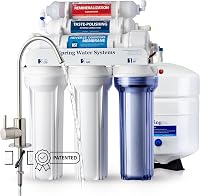
For a system that reduces TDS, the APEC ROES-50 is a 5-stage reverse osmosis system rated for 50 gallons per day. It includes a storage tank, faucet and installation kit, so allow space under the sink for the full setup.
How do installation and upkeep compare?
A whole house system needs access to the main water line; an under sink system needs cabinet and faucet space. Check the installation instructions and measurements before choosing either style.
Some under sink systems need a separate faucet, which may require a hole in the countertop. The Waterdrop TSU specifically requires countertop drilling for its included faucet, while the Aquasana includes a faucet and installation kit.
Maintenance differs by model, too. The Waterdrop's PP filter is due at 6 months, its CT filter at 12 months and its UF filter at 24 months; the system includes lights to indicate filter changes.
Aquasana's filter set lasts up to 6 months or 800 gallons. APEC recommends replacing its filters every 6 to 24 months based on incoming water quality.
Whole house systems also need routine service, but schedules depend on the model and water conditions. Follow the manufacturer instructions and keep a record of filter changes.
Which should you choose for your home?
Pick a whole house filter if you want treatment at several fixtures; pick an under sink filter if your priority is water from one kitchen tap. Let your water test and the exact system's treatment claims decide the final match.
Choose an under sink reverse osmosis system when TDS reduction is part of your goal and the system's listed capabilities fit your water. The under sink reverse osmosis buyer's guide covers tank and tankless layouts.
Choose a whole house system when the coverage matters throughout the home, and verify that its treatment targets and flow capacity suit your needs. If your goal is only drinking and cooking water, a separate sink filter can be the more focused choice.
The simple rule: treat water where you use it, and choose a system based on verified water concerns. Compare the different water filter types side by side before settling on a setup.
Frequently asked questions
Is a whole house water filter better than an under sink filter?
A whole house filter treats water as it enters the home, while an under sink filter treats water at one faucet. Neither is better for every household.
Match the system to where you need filtered water, the contaminants you want addressed and the treatment method suited to your water.
Can an under sink filter treat all water in a home?
An under sink filter is designed to serve a specific faucet, not every tap and appliance. It can be a practical choice when your main goal is water for drinking or cooking.
For showers, laundry and other outlets, look into a whole house system designed for that coverage.
Does a whole house water filter reduce TDS?
TDS reduction depends on the system and its treatment method, so check the exact model's stated capabilities. The Waterdrop TSU and Aquasana Claryum AQ-6300M-BN under sink filters described here do not reduce TDS.
The APEC ROES-50 is a reverse osmosis system with TDS reduction as a feature.
Can you combine a whole house filter with an under sink RO system?
Yes, a home can use whole house treatment for incoming water and a separate under sink reverse osmosis system at the kitchen tap. That adds another treatment step and its own filter upkeep.
Check compatibility and installation instructions for both systems before connecting them.