9 Best NSF-Certified Reverse Osmosis Systems (November 2026)
The best NSF-certified reverse osmosis systems include the iSpring RCC7AK-BN for most homes, the APEC ROES-50 for straightforward filtration, and the Waterdrop G3P600 (best tankless design).
On this page (10 sections)
- The best NSF certified reverse osmosis systems for your kitchen
- How the certified systems compare side by side
- How these certified systems were compared
- What should you measure before buying a certified RO system?
- Which NSF certifications actually matter for reverse osmosis?
- How much water does a household actually need from an RO system?
- What do certified RO systems cost to keep running?
- How long do certified reverse osmosis systems last?
- Which system suits your specific water problem?
- Verdict: the best NSF certified reverse osmosis systems for most kitchens
The best NSF certified reverse osmosis system for most homes is the iSpring RCC7AK-BN, because NSF/ANSI 58 covers the whole unit and the alkaline stage puts minerals back into the water. For a tankless setup, the Waterdrop G3P600 delivers more water per day with a faucet that reports quality.
NSF certification matters because it comes from testing, not a claim. NSF/ANSI 58 tests how well a system reduces contaminants and checks the materials in contact with your water.
That gives you a way to compare these systems by something firmer than a marketing description. Plenty of under-sink units on the market skip that testing entirely.
This roundup covers tanks, tankless units and a few choices in between. If you're still mapping the whole category, our guide to the best reverse osmosis system for home kitchens sets the groundwork.
Our picks at a glance
-
1
-
2

-
3

The best NSF certified reverse osmosis systems for your kitchen
The iSpring RCC7AK-BN fits most homes because of its whole-system certification and mineral stage. The other picks below answer a specific need: tankless space, higher output, a spare filter set or a lower entry point.
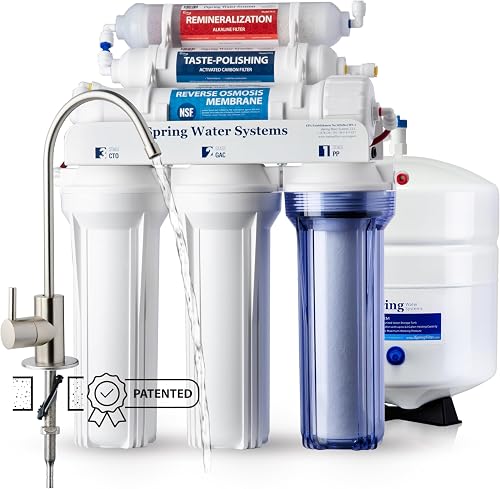
iSpring RCC7AK-BN: Best for most homes
- NSF/ANSI 58 certified whole system
- 75 GPD
- 6 stages with alkaline remineralization
- Patented top-mounted faucet fitting
Whole-system NSF/ANSI 58 certification plus a mineral stage that balances the taste of RO water.
Pros
- Whole-system NSF/ANSI 58 certification
- Alkaline stage adds minerals back
- Transparent first-stage housing shows filter buildup
- Tank design works without power
Cons
- Large 3.2-gallon tank takes cabinet space
- Six stages mean more filters to change
The RCC7AK-BN suits a family that wants certified filtration without giving up taste. Its six stages add a mineral cartridge after the membrane, so the water finishes with a balanced pH instead of the flat taste many people notice in plain RO water.
The whole system holds NSF/ANSI 58 certification, which is a higher bar than certifying one filter inside it. iSpring says the system reduces TDS by 93 to 98 percent, plus lead, fluoride, PFAS and more than 1,000 other contaminants. That covers the common worries in city and well water alike.
Day to day, the 75 GPD membrane and a storage tank mean you get water at normal tap speed until the tank empties. The transparent first-stage housing shows when the sediment filter is loading up, so you change it on evidence rather than a reminder alone.
The top-mounted fitting means the faucet installs from above the counter.
The trade-off is cabinet space. The tank and six-stage body take real room, and that is the price of the no-electricity design.
Replacement filters come as F4AK at 6 months, F9K at a year and the longer-interval sets after that.
APEC ROES-50: Best for straightforward filtration
- NSF certified to 58 and 372
- 50 GPD
- 5 stages
- Quick connection fittings
A simple five-stage tank system with certified parts and a narrow cabinet footprint.
Pros
- Certified to NSF/ANSI 58 and 372
- Compact 15.5 in wide cabinet profile
- Color-coded tubing for DIY setup
- Filter set included with the system
Cons
- Lower 50 GPD output than the top pick
- No mineral stage
APEC's ROES-50 is the pick for a buyer who wants certified parts and a short, clear filter list. Five stages keep the maintenance simple, and the certification covers NSF/ANSI 58 and 372, so both filtration and lead-free materials are checked.
APEC designs, engineers and tests every system in-house.
Its 5.25 in deep body (15.5 x 5.25 x 17 in) is one of the slimmer here, which helps in a shallow cabinet where a bigger system would crowd the disposal. Quick-connect fittings and color-coded tubing shorten a first install, and a filter set ships in the box so you don't order replacements on day one.
The 50 GPD membrane is the practical limit. A large family drawing water all day may outrun the tank and wait for a refill, while a couple cooking and filling bottles will rarely notice.
APEC recommends changing filters every 6 to 24 months based on incoming water quality.
Choose it for simple, certified filtration with an easy filter routine. Step up to the iSpring if you want minerals added back or more daily capacity.
Waterdrop G3P600: Best tankless design
- NSF/ANSI 58, 372 and 42 certified
- 600 GPD
- 8 stages
- Smart display faucet with TDS monitor
High daily output, a low drain ratio and a faucet that shows your water quality.
Pros
- 600 GPD output
- 2:1 pure-to-drain ratio
- Faucet shows TDS and filter life
- Tankless layout frees cabinet space
Cons
- Needs an outlet under the sink
- Drilling two holes in the countertop
The G3P600 suits a kitchen that lacks cabinet space for a tank. Waterdrop's tankless layout saves about 70 percent of the under-sink area, and the 8-stage body mounts flat against the cabinet wall.
The faucet is metal and the body is plastic.
600 GPD changes how the system feels in use. It fills an 8 oz cup in about 8 seconds with no tank refill to wait for, and the 2:1 pure-to-drain ratio means one cup of waste for every two cups of pure water.
An automatic flush cycle runs to keep the water fresh between draws.
The faucet is part of the system: it shows TDS and filter life, so you see the condition of the water without a separate meter. Filters twist out in seconds without tools.
Certification covers 58, 372 and 42 for chlorine and taste.
The trade-off is power. The unit needs an outlet under the sink and stops during an outage.
It also needs two holes drilled, one for the faucet and one for the drain. Measure your cabinet against its 18.12 x 5.67 x 17.72 in body first.
FS-TFC 5-Stage Reverse Osmosis Water Filter System: Best compact tank system

- NSF certified
- 100 GPD
- 5 stages
- 4 extra replacement filters included
A small cabinet footprint with a high flow rate and spare filters in the box.
Pros
- Compact 11.5 in cabinet body
- Fast full flow rate
- 4 extra filters included
- 1:1 drain ratio
Cons
- Tank adds separate footprint
- Shorter filter life cycle than some picks
FS-TFC fits a small cabinet that a full-size system would fill. The main body is 11.5 in on each side, and the separate 3.2-gallon tank gives you flexibility to slide it into a corner.
A 304-grade stainless steel faucet comes in the kit.
The 100 GPD rating comes from twin 50 GPD membranes, and the maker says a 200 ml cup fills in about 5 seconds at 60 psi. Four spare filters ship in the box, which covers close to a year of changes.
The stated annual filter cost works out to about 13 cents a day.
It runs on water pressure alone, so there's no outlet to find and no pump to fail. The 1:1 drain ratio treats wastewater better than older designs.
It handles feed water up to 500 ppm TDS and pressure from 30 to 85 psi.
This is the practical pick where space is tight but certified filtration still matters. The shorter filter life cycle means more changes per year than the iSpring.
iSpring RCC7-BN: Best for simple certified filtration

- NSF/ANSI 58 certified whole system
- 75 GPD
- 5 stages
- Top-mounted faucet fitting
The same iSpring body and faucet design as the top pick, without the alkaline and UV extras.
Pros
- Whole-system NSF/ANSI 58 certification
- Transparent first-stage housing
- Runs without electricity
- Check valve prevents backflow
Cons
- No mineral stage
- Fewer stages than the RCC7AK-BN
The RCC7-BN is the stripped-back version of the top pick. You get the same NSF/ANSI 58 whole-system certification, the same top-mounted faucet fitting and the same 75 GPD output, minus the alkaline stage and the UV lamp.
iSpring has sold it to American homes for more than 15 years.
That matters if you simply want clean, certified water with no interest in remineralizing. Five stages still reduce more than 1,000 contaminants, and the check valve prevents backflow into your supply.
The AS-material filter housing resists impact and still lets you check filter condition.
The cabinet footprint is similar to the RCC7AK-BN, so space is not the deciding factor here. Your taste is: if plain RO water suits you, this saves money on filters over the years.
The system handles source water up to 750 ppm TDS and reduces TDS by 80 to 90 percent.
Buy it for certified filtration at the simplest setup. Choose its bigger sibling when minerals or UV protection are what you're after.
iSpring RCC7AK-UV: Best for extra protection

- NSF/ANSI 58 and 372 certified
- 75 GPD
- 7 stages
- LED UV filter with smart flow activation
Alkaline minerals plus a UV stage that switches on when water flows.
Pros
- Whole-system NSF/ANSI 58 and 372 certification
- LED UV lamp works only when water moves
- Alkaline stage adds minerals
- Layered cartridges rather than composite blocks
Cons
- UV lamp needs an outlet
- Seven stages raise replacement costs
The RCC7AK-UV is for buyers who want the alkaline stage plus an extra layer against bacteria and viruses. The LED UV lamp is mercury-free and switches on only when water flows, so it does not run all day.
It is an 11W Philips lamp in stainless steel housing.
iSpring gives this unit NSF/ANSI 58 and 372 certification across the whole system, and the seven stages use individually layered cartridges rather than compressed composite blocks. The maker says that gives deeper filtration with visible media in each stage.
The second and third stages combine GAC and CTO carbon for more chemical protection than carbon block alone.
The UV stage has a real cost: the lamp needs an outlet, so this becomes a powered system. Seven stages also mean more filters to replace across a year. iSpring notes the water runs briefly warm after the UV stage sits idle.
Choose it for households on well water or anyone who wants both minerals and UV in one cabinet. If your pressure is below 45 psi, iSpring points to its booster-pump model instead.
Waterdrop WD-T4-A: Best tankless with alkaline water

- NSF/ANSI 372 certified
- 450 GPD
- 10 stages
- Dual flow faucet with alkaline and standard streams
Two water streams from one faucet, with an alkaline line and a plain RO line.
Pros
- Switch between alkaline and standard streams
- 450 GPD output
- 2:1 pure-to-drain ratio
- Filter reminder lights and buzzer
Cons
- Needs an electrical connection
- Countertop drilling required for the faucet
Waterdrop's WD-T4-A is for a household that wants two kinds of water from one tap. The dual flow faucet pours either plain RO water or an alkaline mineral stream, and you choose with a lever.
Dual LED lights show the water's status from filtration through to the faucet.
The 450 GPD rating and 2:1 pure-to-drain ratio put it close to the G3P600 on speed, while the tankless body frees up cabinet space. Indicator lights and a buzzer tell you when a filter is due.
Replacement intervals are set at 6 months for the carbon filter, 12 months for the carbon block and mineralizer, and 24 months for the membrane.
Certification is narrower here: the system carries NSF/ANSI 372 for lead-free materials. That covers the materials rather than the full filtration standard, which is why it scores below the Waterdrop tankless unit above.
The system plugs in, and its faucet needs a drilled hole. It suits a kitchen remodel where you can plan the wiring and drilling up front.
Express Water RO5DX: Best for a full starter kit

- NSF certified 58 and 372
- 50 GPD
- 5 stages
- Leak detector and extra filter set included
An all-in kit with a spare filter set and leak detector for first-time buyers.
Pros
- Extra filter set and leak detector in the box
- NSF/ANSI 58 and 372 certification
- Works without electricity
- Fast flow faucet
Cons
- 50 GPD is the lowest output here
- 31 lb shipping weight is heavy
The RO5DX is the easiest system to start with because the box arrives ready for a first year. Express Water includes a spare filter set and a leak detector, so you have replacements and early warning before the first change comes due.
A chrome faucet and tank stand are in the kit too.
It carries NSF/ANSI 58 and 372 certification and reduces lead, chlorine, fluoride, PFAS and more through five stages. The fast flow faucet pours at 0.8 gpm, quicker than many standard faucets.
The 4-gallon tank holds about 3.2 gallons of usable water.
The 50 GPD membrane is tied for the lowest output in this group, so it suits a small household rather than a busy family. The system ships at 31 lb, so plan a two-person lift for the tank and body.
It supports feed water up to 300 ppm TDS and 40 to 80 psi.
Buy it if you want certified filtration and the parts to keep it running without a second order. Step up in output if your household is larger.
APEC RO-90: Best for high daily demand

- WQA Gold Seal certified
- 90 GPD
- 5 stages
- Large-capacity filters
The highest daily output among the tank systems here, with filters built to last longer between changes.
Pros
- 90 GPD capacity
- Super-capacity filters cut change frequency
- US-assembled system
- Lead-free designer faucet
Cons
- No mineral stage
- Premium price tier
The RO-90 suits a busy kitchen that uses a lot of filtered water. At 90 GPD, it produces the most water of any APEC tank system here, so the tank recovers faster after a big cooking session.
It fills the same compact 16 x 5.25 x 17.5 in cabinet profile as the smaller APEC.
APEC builds it with super-capacity filters the maker says last twice as long between changes, which cuts the annual replacement count and the cost of keeping certified water on tap. It holds WQA Gold Seal certification, a third-party check similar in purpose to NSF testing.
The RO membrane is a FILMTEC unit from Dow.
It runs on water pressure alone and uses JG quick-connect fittings that seal without extra clips. The designer faucet is lead-free.
The maker says it removes up to 99 percent of contaminants, arsenic and fluoride included.
The trade-off is that there's no mineral stage and the system sits at a premium price tier. Choose it for volume and long filter life rather than taste polishing.
How the certified systems compare side by side
The iSpring RCC7AK-BN leads on certification and minerals, while the Waterdrop G3P600 wins on speed and cabinet space. The table shows capacity, stages and power needs together so you can line up your cabinet against each one.
| Product | Best for | Capacity | Stages | Power | Our score |
|---|---|---|---|---|---|
| iSpring RCC7AK-BN | most homes | 75 GPD | 6 | No electricity needed | 9.1 |
| APEC ROES-50 | straightforward filtration | 50 GPD | 5 | AC power source | 8.9 |
| Waterdrop G3P600 | tankless design | 600 GPD | 8 | Under-sink electricity required | 8.8 |
| FS-TFC 5-Stage Reverse Osmosis Water Filter System | compact tank system | 100 GPD | 5 | No electricity needed | 8.7 |
| iSpring RCC7-BN | simple certified filtration | 75 GPD | 5 | No power needed | 8.1 |
| iSpring RCC7AK-UV | extra protection | 75 GPD | 7 | Corded electric for the UV lamp | 8.0 |
| Waterdrop WD-T4-A | tankless with alkaline water | 450 GPD | 10 | Plug-in required | 7.8 |
| Express Water RO5DX | a full starter kit | 50 GPD | 5 | No power needed | 7.8 |
| APEC RO-90 | high daily demand | 90 GPD | 5 | Water pressure only | 7.6 |
How these certified systems were compared
We started from the certification each system carries, because that is the first real filter for an RO buyer. A whole-system NSF/ANSI 58 listing, like the iSpring RCC7AK-BN and RCC7-BN, carries more weight than a single-component claim.
The APEC RO-90's WQA Gold Seal sits in the same family of third-party checks.
We looked at the specs next: gallons per day, stage count, tank versus tankless, and whether the unit needs power. Those numbers decide how the system fits daily life, from waiting for a tank to the outlet you must find.
A tankless model's drain ratio also matters, since it sets how much water leaves the house as waste.
Buyer-style fit came last. A 50 GPD system is fine for two people and risky for a family of five, and a tankless unit is only as good as your cabinet's wiring.
The 3.2-gallon tank on most of these units is the reserve you draw from at full speed.
Our score weighs specs, features and certification against what most homeowners want from an RO system. No one has been into your kitchen, so match the numbers to your cabinet before you order.
What should you measure before buying a certified RO system?
Start with the inside of your cabinet, and write down width, height and depth before you look further. A tank system needs room for both the filtration body and the storage tank, usually side by side.
The iSpring RCC7AK-BN body runs about 15.5 x 16 x 18 in, and its tank adds its own footprint. The APEC ROES-50 is far narrower at 5.25 in, which helps when the disposal takes the middle of the cabinet.
The FS-TFC body is the smallest at 11.5 in on each side, with its tank placed separately.
Leave extra space behind and above the system for tubing bends and filter changes. A unit that fits but cannot be serviced will be a nuisance every six months.
Does a tank or tankless system suit your kitchen?
Tank systems store water under pressure and pour at full speed until empty, using no electricity. Tankless models like the Waterdrop G3P600 and WD-T4-A make water on demand and free up cabinet space, but they must plug in.
The tank also acts as a buffer against slow production.
Where does the drain line go?
Every RO system sends some water to the drain through a saddle valve on the sink pipe. Most DIY kits include the saddle valve.
Check you have a few inches of straight pipe to clamp it to. The Express Water kit adds a leak detector near the system as a safety net.
Can you hook a certified RO system to your fridge?
Many units feed a fridge ice maker, and iSpring sells an ice maker kit as an add-on. Run the tubing before you finish the install, since the line often has to pass through cabinet walls.
Length of run matters, so keep the fridge close to the system.
Which NSF certifications actually matter for reverse osmosis?
NSF/ANSI 58 is the one that matters most, because it is the standard written for point-of-use RO systems. It covers contaminant reduction and the materials that touch drinking water.
Whole-system certification means the unit is tested as it ships.
NSF/ANSI 372 covers lead content in the wetted materials, a separate concern. A system can carry 372 without full 58 certification, and the WD-T4-A is one example in this roundup.
NSF/ANSI 42 adds chlorine, taste and odor reduction, which the Waterdrop G3P600 carries.
WQA Gold Seal, which the APEC RO-90 carries, is a similar third-party program run by the Water Quality Association. It tests material safety and contaminant rejection the way NSF does.
Look for the phrase "whole system" or "entire system" if you want the strongest claim. A unit certified as a whole is tested as it ships, not filter by filter.
How much water does a household actually need from an RO system?
A typical household uses roughly 1 to 3 gallons of drinking and cooking water a day, which most systems here can supply. The daily rating matters most when several people draw water in the same hour.
The rating is the maximum the membrane makes over a full day, not the speed from the faucet.
At 50 GPD, a tank refills slower than at 90 GPD, but a tank also stores a reserve. Families picking up the pace often prefer the APEC RO-90 or a tankless unit at 450 GPD or more.
The tankless units here fill a cup in 8 seconds or less.
Water temperature and pressure change real output. A cold kitchen slows any membrane, so expect less than the rating in winter.
Low inlet pressure holds output back too, and iSpring suggests a booster-pump model when pressure falls below 45 psi.
What do certified RO systems cost to keep running?
The filters, not the purchase, set the long-term cost. iSpring sets a 6-month schedule for the first filter set and longer gaps for membrane and mineral stages, so a six or seven-stage unit costs more per year than a five-stage one.
Systems with super-capacity filters, like the APEC RO-90, cut the number of changes. FS-TFC includes four spare filters to cover the first year and lists its yearly filter cost at about 13 cents a day, while the Express Water kit ships with a full set. iSpring lists its own running cost at roughly 17 cents a day.
Check the replacement schedule before you buy. A cheap system with a short filter life can cost more over five years than a pricier one with long intervals.
The stage count is the best clue to how many filters you will buy each year.
That timeline is also where the reverse osmosis system under 300 budget picks come in, since a lower entry price leaves more room for filters later.
How long do certified reverse osmosis systems last?
The membrane usually runs 2 to 3 years and the whole system 10 or more with regular filter changes. Housings, tubing and the tank are the parts that age, and certified systems tend to use parts rated for the pressure. iSpring lists spare part availability for three years.
Filter discipline is the single biggest factor. Sticking to the sediment schedule protects the membrane, and that is the part most likely to be replaced first.
The clear first-stage housing on the iSpring units makes that easy to judge by eye.
For a full breakdown by component and water type, see our guide on how long do reverse osmosis systems last.
Which system suits your specific water problem?
Nitrates are a common reason people move to RO, since the membrane handles them well. If your water report shows high nitrates, our roundup of the reverse osmosis system for nitrates narrows the choice.
The RO membrane's 0.0001 micron pore size is what does the work.
Well water raises different questions. Bacteria and viruses call for the UV stage on the iSpring RCC7AK-UV, while hard water makes the sediment filter and membrane work harder.
A clear housing helps you catch that early.
For most other homes, the decision comes down to cabinet space and electricity. A tank unit with whole-system certification is the safe default.
The iSpring RCC7AK-BN remains the pick for most people, with minerals added back and certification across the whole system. The Waterdrop G3P600 takes the tankless slot when space and speed matter more than an outlet.
Verdict: the best NSF certified reverse osmosis systems for most kitchens
Buy the iSpring RCC7AK-BN if you want a certified whole-system unit with minerals in the glass and no outlet needed. Choose the Waterdrop G3P600 for a tankless install in a small cabinet, or the APEC ROES-50 for simple certified filtration at a lower output.
The FS-TFC suits the tightest space, and the APEC RO-90 fits a large household drawing water all day. The rest fill narrower needs: UV protection, a two-stream faucet or a starter kit with spares.
When you compare NSF certified reverse osmosis systems, start with the certification on the box, then match the tank, stages and power to your cabinet. That order keeps you from buying water capacity you won't use or a unit that won't fit.
Our top 3 picks at a glance
-
1
-
2
-
3
Frequently asked questions
What does NSF/ANSI 58 certification cover?
NSF/ANSI 58 is the standard for point-of-use reverse osmosis systems. It covers contaminant reduction performance and the materials that touch your water.
A whole-system certification means the complete unit was tested, not just one part.
Do all NSF certified reverse osmosis systems use the same certification?
No. Some carry NSF/ANSI 58 for filtration performance, some add NSF/ANSI 372 for lead-free materials, and some list only a single standard.
Check that the certification covers the whole system rather than one component.
How much space does a tank RO system need under the sink?
Most need a cabinet roughly 16 in wide, 18 in tall and 24 in deep to hold both the system and the storage tank. Measure your cabinet and the tank together before ordering, then leave room for the tubing bends.
Can a certified reverse osmosis system run without electricity?
Yes. Tank systems that use line pressure to push water through the membrane need no power.
Tankless models use a pump, so they require an outlet under the sink and stop working in a power cut.
How often do filters need changing on a certified system?
Most makers set sediment and carbon pre-filters at 6 to 12 months and the RO membrane at 2 to 3 years. Follow the schedule for your model and test your water if you notice a change in taste or flow.