Does a Reverse Osmosis System Remove Fluoride?
Yes, a reverse osmosis system removes fluoride. The RO membrane blocks dissolved fluoride ions along with most other minerals, and a working under-sink system typically cuts fluoride by more than 90%.
On this page (8 sections)
- Does a reverse osmosis system remove fluoride from tap water?
- How much fluoride does an RO membrane actually remove?
- What slows down fluoride removal over time?
- Do all reverse osmosis systems remove fluoride equally well?
- Does fluoride removal change the taste or the minerals in the water?
- How do you keep fluoride reduction high after installation?
- What should you expect if your water has very high fluoride?
- So, does a reverse osmosis system remove fluoride well enough to rely on?
Yes, a reverse osmosis system removes fluoride. The RO membrane blocks dissolved fluoride ions along with most other minerals, and a working under-sink system typically cuts fluoride by more than 90%.
That is the short version. The longer answer covers why the membrane works, what slows it down, and how to keep removal high.
Does a reverse osmosis system remove fluoride from tap water?
It does, because of the membrane at the center of the system. A thin semi-permeable sheet lets water molecules pass while rejecting most dissolved ions, fluoride included.
The water is pushed across the membrane under pressure, so clean water collects on one side and the rejected minerals, fluoride among them, get flushed to the drain. The carbon stages before the membrane mainly protect it and improve taste.
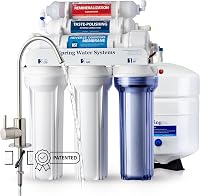
iSpring says its RCC7AK-BN reduces fluoride by more than 97.4%, and the system is certified to NSF/ANSI 58 for the full unit. APEC lists fluoride among the impurities its ROES-50 handles on the way to 50 gallons per day.
The membrane's job is size-based rejection. Fluoride ions are small, but they carry a charge and are surrounded by water molecules, so the membrane pore structure and the pressure crossing it decide how many get through.
A system that has lost pressure or has a worn sheet lets more of them pass.
A carbon-only pitcher filter won't do this. It handles chlorine and some taste issues, but fluoride slips through.
How much fluoride does an RO membrane actually remove?
Expect well over 90% on a healthy system. The exact figure moves with your water pressure, water temperature, the membrane's age, and the fluoride level going in.
iSpring's published reduction for fluoride is greater than 97.4%, with TDS cut 93 to 98% overall. That TDS number is a good quick check: if total dissolved solids drop sharply, fluoride is dropping with them.
Cold incoming water and low pressure reduce output and can lower rejection slightly. The iSpring runs at an operating pressure of 70 psi, and the APEC ROES-50 at 40 to 85 psi.
Express Water puts its RO5DX range at 40 to 80 psi and notes that a booster pump or pressure regulator may be needed outside it.
Below 40 °F the feed water thickens and the membrane produces more slowly, which matters in unheated utility areas. All three brands list 40 °F or close to it as the low end.
If you want to see the actual numbers in your kitchen, a TDS meter before and after the system tells you whether the membrane is doing its job.
What slows down fluoride removal over time?
Clogged pre-filters, an aging membrane, and low pressure are the three usual causes. Each one reduces the push across the membrane or lets more minerals pass.
The sediment and carbon stages collect particles and chlorine so the membrane isn't overloaded. When they load up, pressure at the membrane drops and fluoride rejection falls with it.
Membranes also age. Over time the polymer loses some of its rejection rate, and the output slows.
iSpring recommends the F4AK set every 6 months, the F9K at 1 year, and the F19K75 and F28K75 membrane and filter kits at 2 and 3 years. APEC recommends filter changes every 6 to 24 months based on incoming water quality.
One design detail helps here. The iSpring's transparent first-stage housing lets you see sediment buildup without opening anything, so you can judge when a change is due instead of guessing from a calendar alone.
Do all reverse osmosis systems remove fluoride equally well?
No, and the membrane is the reason. A certified system with a good pre-filter stack holds its fluoride rejection longer than a budget unit with thin stages.
Look for NSF/ANSI 58 certification on the whole system, not just one part. iSpring says the RCC7AK-BN is certified to that standard for the entire system, and APEC's ROES-50 carries NSF 58 and 372 certification. Express Water's RO5DX is also certified to NSF standards 58 and 372.
Tank size and daily output matter too, though not for fluoride itself. A 75 GPD unit like the iSpring refills faster than the 50 GPD APEC and Express Water models.
For a small kitchen or rental, a compact reverse osmosis system for apartment keeps the same membrane chemistry in a smaller footprint. A full reverse osmosis system for home suits bigger households that want a large tank and faster recovery.
Which system suits a tight budget?
The APEC ROES-50 is the value pick. It runs 50 gallons per day through 5 stages, includes a tank, faucet, and install kit, and APEC lists fluoride among the impurities it removes.
It fits under most sinks at 15.5 by 5.25 by 17 inches. The slim cabinet profile is the main reason it shows up in tighter kitchens.
Connection options are part of the fit. The APEC uses quick-connect fittings and color-coded tubing, and the iSpring adds a convertible adapter that works with both 1/2 inch NPT and 3/8 inch compression fittings.
If cost is the deciding factor, our guide to the reverse osmosis system under 300 compares the models that stay in that range without dropping the membrane.
What about a system with a leak detector and spare filters?
Express Water's RO5DX ships with an extra filter set and a leak detector, which suits a first-time RO buyer who wants spares on hand from day one.
Express Water says it reduces up to 99.99% of fluoride alongside lead, chlorine, and arsenic. It needs no electricity, and it runs on 40 to 80 psi.
The 4-gallon tank works for a couple or a small family. Large households may empty it faster than it refills.
Does fluoride removal change the taste or the minerals in the water?
It does, and some people notice. The membrane strips fluoride along with calcium, magnesium, and other dissolved minerals, so the water can taste flat.
That is why remineralizing stages exist. The iSpring RCC7AK-BN adds a mineral stage after the membrane to bring back a balanced pH and some essential minerals, which also improves the mouthfeel.
For most people the difference is small. If you brew coffee or tea and care about the flavor, a remineralized system is the easier choice than adding minerals yourself.
Fluoride itself has little taste at normal tap levels, so the change you notice after installing RO is usually the missing minerals, not the missing fluoride.
How do you keep fluoride reduction high after installation?
Change the pre-filters on schedule and watch the output. The membrane only rejects fluoride well while it is protected and under proper pressure.
- Replace sediment and carbon stages at the interval the brand gives.
- Check the tank refill time every few months; slower refills point to a tired membrane.
- Test TDS before and after when you notice a change in taste.
- Sanitize the tank and lines if the system sits unused for weeks.
If the TDS after the membrane creeps up toward the tap reading, the membrane is spent. Replace it rather than waiting.
A membrane that still fills the tank but passes more minerals is the quiet failure mode, since nothing looks wrong from the outside.
Our guide on whether a reverse osmosis system removes arsenic covers the same membrane logic for another common contaminant, and the checks are the same.
What should you expect if your water has very high fluoride?
A standard RO system still helps, but the membrane works harder. Municipal supplies in the US sit well within normal ranges, so this is mostly a concern for private wells.
If your well tests above the usual drinking-water limit, more frequent membrane changes and a TDS check after installation make sense. A larger system recovers faster between draws.
For a household with high demand, the 75 GPD iSpring is the better fit than either 50 GPD model. It refills the storage tank quicker and lists fluoride reduction above 97.4%.
It also lists removal figures for barium, cadmium, chromium, copper, lead, and selenium, which is useful when a well test flags more than fluoride.
Pair any system with a pre-sediment filter if your water carries grit or iron. Protecting the membrane is what keeps fluoride removal steady.
So, does a reverse osmosis system remove fluoride well enough to rely on?
Yes, a reverse osmosis system removes fluoride reliably when the membrane is healthy and the pre-filters are fresh. Expect well above 90% reduction, with the iSpring RCC7AK-BN quoting more than 97.4%.
Pick the iSpring if you want the highest removal and a mineral stage. Choose the APEC ROES-50 for a slim, budget-friendly 5-stage setup, or the Express Water RO5DX if the spare filters and leak detector tip the balance.
Whatever you buy, the maintenance rule is the same: replace the pre-filters on time and the membrane when output drops. That schedule is what keeps the fluoride answer a firm yes.
Frequently asked questions
How much fluoride does reverse osmosis remove?
Most of it. iSpring says its RCC7AK-BN reduces fluoride by more than 97.4%, and APEC lists fluoride among the contaminants its ROES-50 filters out. A healthy membrane with correct water pressure does the heavy lifting.
Does a carbon filter alone remove fluoride?
No. Standard carbon block and granular carbon stages improve taste and cut chlorine, but they don't pull fluoride out of the water.
Fluoride needs the reverse osmosis membrane; the carbon stages mostly protect that membrane.
Will boiling water remove fluoride?
No. Boiling leaves fluoride behind and actually raises its concentration as water evaporates.
Reverse osmosis is the practical home method; distilling also works but is slower and uses more energy.
Does the fluoride removal stop when the filters get old?
It slows as the membrane ages or the sediment and carbon stages clog. Change the pre-filters on schedule and swap the membrane when production drops or the water tastes off, since a tired membrane passes more dissolved minerals through.