9 Best Reverse Osmosis Systems for Well Water (November 2026)
The best reverse osmosis systems for well water include the iSpring RCC7AK-BN for most well water homes, the APEC ROES-50 for low-pressure well lines, and the Waterdrop G3P600 (best tankless for clear well water).
On this page (8 sections)
- The best reverse osmosis systems for well water, by job
- How these well water RO systems compare
- How we compared these systems
- What should you check before buying an RO system for a well?
- How long do well water RO filters last?
- Do RO systems waste water on a well?
- Which RO system fits your kitchen and budget?
- The verdict on the best RO system for well water
The best reverse osmosis system for well water for most homes is the iSpring RCC7AK-BN, because its 6 stages start with a clear sediment filter that protects the membrane and its NSF 58 certification covers the full system. The Waterdrop G3P600 is the pick if your well water runs clear and you want cabinet space back.
Well water asks more of an RO system than city water does. Dirt, grit and iron load up filters faster, and a well pump can deliver less pressure than the membrane wants.
So the first question is not which brand looks best but which system survives your supply.
This guide covers nine systems we compared on stages, rated pressure, drain ratio and installation type. Every one gets a badge for the well water job it does best.
Our picks at a glance
-
1
-
2

-
3

- 4
 Check it
Bluevua RO100ROPOT Countertop Reverse Osmosis Water Filter
Best for renters on well water - 5
 Check it
DREO Reverse Osmosis Water Filter Countertop
Best for small kitchens with hard water - 6
 Best for sediment-heavy well waterCheck it
- 7
 Best budget tankless optionCheck it
- 8
 Best for large households on a wellCheck it
- 9
 Best for tight cabinets and rentalsCheck it
The best reverse osmosis systems for well water, by job
The iSpring wins on pre-filtration and certification, which is what a dirty well supply needs most. The other picks handle low pressure, tight cabinets, renters and large households better.
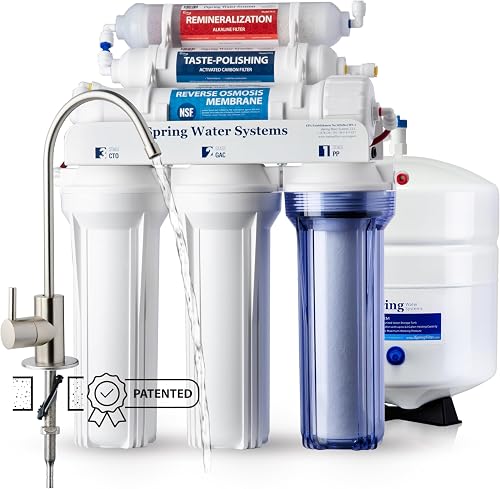
iSpring RCC7AK-BN: Best for most well water homes
- 6-stage filtration with mineral AK stage
- NSF/ANSI 58 certified for the whole system
- 75 GPD with no electricity needed
- Transparent first-stage housing
A 6-stage system with a mineral stage and a clear sediment housing, so you can see when well water dirt is loading up the first filter.
Pros
- Whole-system NSF 58 certification
- Clear first-stage housing for well sediment
- Mineral stage balances pH
- No electricity required
Cons
- Tank takes under-sink room
- Needs about 70 psi to hit its rated flow
The iSpring RCC7AK-BN earns the top spot because its filtration is built for water that arrives with grit in it. A transparent first-stage housing lets you watch the sediment filter load up, so you replace it before the membrane suffers.
Six stages include a mineral AK stage that adds back minerals and balances pH after the membrane strips everything out. iSpring says the system reduces TDS by 93 to 98 percent and also covers PFAS, lead, fluoride and more than 1,000 other contaminants. The mineral stage is the part that separates it from every other tank system here.
NSF/ANSI 58 certification applies to the whole system, not just one cartridge. The 75 GPD membrane runs without electricity, so a power cut at the well pump does not stop the faucet.
The top-mounted fastener also lets you set the faucet from above the counter, which saves time on a first install.
The trade-off is space: the storage tank needs a real cabinet. The rated range sits near 70 psi, so a weak well pump may call for a booster.
Replacement filters come in 6-month, 1-year, 2-year and 3-year packs, so you can buy ahead for a dirty supply. If your well water is cloudy or gritty and your cabinet has room, this is the one to buy.
APEC ROES-50: Best for low-pressure well lines
- 5-stage filtration, 50 GPD
- Quick-connect fittings and colored tubing
- Rated for 40-85 psi inlet pressure
- Brushed nickel faucet and tank included
A 5-stage tank system with a 40 psi floor on inlet pressure, which matters on a well pump that runs at the low end of the usual range.
Pros
- Lower rated pressure floor than the iSpring
- Simple quick-connect install
- Compact cabinet footprint
Cons
- No mineral stage
- 50 GPD is tied for the slowest tank flow here
APEC's ROES-50 suits a well pump that runs on the low side. It lists an operating range of 40 to 85 psi, lower than the iSpring's 70 psi figure, so it has a better chance of working without a booster pump.
A pump that dips toward 40 psi still leaves this system within spec.
Five stages handle the usual sediment, carbon and membrane work, and APEC says the filters remove up to 99.99 percent of impurities, including arsenic, lead, fluoride and PFAS. Quick-connect fittings and colored tubing keep the install simple for a first-time DIY job.
The brushed nickel faucet and tank come in the box.
The 50 GPD membrane is tied for the slowest rated tank flow here, and there is no mineral stage to put taste back. Its cabinet footprint is narrower than the iSpring at 5.25 inches wide, which helps in a shallow cabinet.
For one or two people filling glasses and a coffee pot, that pace is fine. For a family of five cooking and making ice all day, the tank will empty faster than it refills.
APEC recommends filter changes every 6 to 24 months depending on incoming water quality.
Pick it when low pressure is your main worry. Skip it if you want remineralized water or a bigger daily supply.
Waterdrop G3P600: Best tankless for clear well water
- 8-stage filtration, 600 GPD
- 2:1 pure-to-drain ratio
- Smart display faucet with TDS readout
- Saves about 70% of under-sink space
A tankless 8-stage system with a faucet display that shows TDS and filter life, best where sediment is already handled upstream.
Pros
- 600 GPD flow fills a glass in seconds
- 2:1 drain ratio wastes less water
- Faucet shows water quality and filter life
Cons
- Needs under-sink electricity
- pp cotton pre-filters are integrated cartridges, not a separate sediment stage
The Waterdrop G3P600 is the strongest tankless choice for a well supply that is already clear. Eight stages include a TDS monitor in the faucet and a filter-life tracker, so you can see when the water quality changes.
Both readings come from the faucet itself, so you never have to guess whether the membrane is keeping up.
It produces 600 gallons a day and fills an 8 oz cup in about 8 seconds. The 2:1 pure-to-drain ratio means one cup of waste for every two cups of pure water, which matters when every gallon comes from your own well.
An automatic flush cycle keeps the membrane rinsed between draws.
Going tankless frees about 70 percent of the cabinet space the iSpring's tank would use. Filters twist out in seconds without moving the unit or reaching for tools.
Waterdrop also lists NSF/ANSI 42 and 372 certification alongside the 58 rating, plus FCC and UKCA safety marks.
The pp cotton pre-filters in its CF and RO cartridges do catch grit, but dirty well water loads them faster than a city supply would, so plan on more frequent changes. The unit also needs an under-sink outlet.
Measure your cabinet against its 18.12 inch length before you buy. Buy it for a clean, tested well supply and a small kitchen.
If your water still carries heavy dirt, add a whole-house sediment filter first.
Bluevua RO100ROPOT Countertop Reverse Osmosis Water Filter: Best for renters on well water
- 6-stage filtration with UV and remineralization
- No plumbing or installation
- Borosilicate glass carafe
- 2:1 pure-to-drain ratio
A plug-in countertop unit with UV and remineralization stages, so a renter gets RO water without cutting into a rented cabinet.
Pros
- No plumbing changes at all
- UV stage adds a barrier after the membrane
- Glass carafe instead of plastic
Cons
- Small 1700 ml capacity
- Slower than under-sink models
The Bluevua RO100ROPOT is the answer for renters who cannot cut into cabinets or add plumbing. It sits on the counter, plugs into any outlet and needs no installation at all.
You fill it, it filters, and the water lands in a carafe you carry to the table.
Six stages include a UV light and a remineralization filter. Bluevua says the 0.0001μm membrane reduces TDS, PFOA, PFOS, chlorine, fluoride, arsenic and lead while the mineral stage improves taste.
The water collects in a borosilicate glass carafe rather than a plastic tank, so the finished water never sits in plastic. WQA testing against NSF/ANSI/CAN 372 covers lead-free materials.
The 1700 ml capacity is small, and the 2:1 drain ratio is respectable for a countertop unit. It runs on low power and drops into a standby mode when idle.
A display tracks filter life and water quality, and the filters last 12 to 24 months. This is a personal drinking water machine, not a whole-kitchen supply.
A well-water household that cooks with tap water will empty it quickly.
Choose it for an apartment or rental with a questionable well supply and no room to plumb anything. Skip it if you need water for cooking and ice at volume.
DREO Reverse Osmosis Water Filter Countertop: Best for small kitchens with hard water
- 7-in-1 RO filtration
- 3:1 pure-to-drain ratio
- Autofill pitcher and self-cleaning cycle
- TDS and filter-life display
A countertop RO with the best drain ratio in this group and a self-cleaning cycle, handy when well water leaves mineral scale behind.
Pros
- 3:1 pure-to-drain ratio
- Self-cleaning cycle reduces scale upkeep
- Autofill pitcher holds 3 liters
Cons
- Counter space required
- Filter changes come every 6 months
DREO's countertop RO earns a place for hard well water in a small kitchen. Its 3:1 pure-to-drain ratio is the best here, so it throws away the least water per gallon made.
On a well with a septic field, that matters more than it does in a city apartment.
Seven filtration stages include a self-cleaning cycle that helps with the mineral scale hard well water leaves behind. DREO says the system was tested by SGS to meet NSF/ANSI 58 and filters out 99.9 percent of contaminants including PFOA, PFOS, chlorine and fluoride.
The autofill pitcher holds 3 liters, and the display shows TDS and filter life so you know when the water quality shifts. Touch controls run the cycle without a separate app.
The unit is rated for source water up to 1200 ppm TDS, far beyond what most wells produce, which gives it headroom on mineral-heavy supplies. Filters change every 6 months.
It measures 14.5 inches long, so it needs real counter room next to the sink.
It still needs counter space and an outlet, and 3 liters is a household supply only for one or two people. Pick it for hard water and a compact kitchen.
Skip it if your priority is a large volume of cooking water.
Express Water RO5DX: Best for sediment-heavy well water
- 5-stage filtration, 50 GPD
- Leak detector and spare filter set included
- No electricity needed
- Rated for 40-80 psi
A 5-stage tank system sold with a spare filter set and a leak detector, so a dirty well supply has replacements on hand from day one.
Pros
- Spare filter set included
- Leak detector in the box
- Low 40 psi rated floor
Cons
- No mineral stage
- Heaviest tank system here at 31 lb
Express Water's RO5DX is built for the dirtiest well supplies in this group. It ships with a spare filter set and a leak detector, so you start with replacements on hand and a warning if a fitting drips.
That spare set covers the first year of use, which softens the cost of running RO on a dirty well.
The 5-stage system reduces up to 99.99 percent of impurities according to Express Water, including PFAS, lead and fluoride. It runs without electricity and works from 40 psi, so a modest well pump is enough.
The deluxe chrome faucet delivers 0.8 gpm, a fast flow for a tank system.
The 4-gallon tank holds 3.2 gallons of water, which buffers a busy kitchen between refills. It is the heaviest tank system here at 31 lb, so plan the install before you lift it into a cabinet.
Express Water lists compatibility with both 3/8 inch and 1/2 inch under-sink connections, and you can wall-mount it or let it stand.
There is no mineral stage, so the water tastes flat compared with the iSpring. Buy it when sediment and grit are the daily problem and you want spares in the box.
Skip it for a small cabinet or a light-use kitchen.
Waterdrop G2: Best budget tankless option
- 7-stage filtration, 400 GPD
- 1:1 pure-to-drain ratio
- Tankless design saves cabinet space
- Twist-and-pull filter changes
A 400 GPD tankless system that costs less than the G3P600 while still saving cabinet room, best for small, clean well supplies.
Pros
- Cheaper tankless route
- 1:1 drain ratio
- Fast filter swaps
Cons
- Needs electricity
- Two-thirds the daily capacity of the G3P600
The Waterdrop G2 is the budget way into tankless RO. It produces 400 gallons a day with a 1:1 pure-to-drain ratio and saves over 70 percent of under-sink space compared with a tank system.
That 1:1 ratio means one cup of waste for every cup of pure water, a step up from older tank designs.
Seven stages cover the filtration, and the twist-and-pull filters swap in about 3 seconds. Installation takes under 30 minutes for a confident DIYer, though it needs an outlet and drilled holes for the faucet and drain.
A mechanical faucet comes in the box, so there is no display to wire.
Against the G3P600, you give up two-thirds of the daily capacity, a lower drain ratio and the smart faucet display. Against the iSpring, you give up the mineral stage.
The rated inlet range starts at 14.5 psi, so it tolerates weak pressure better than the tank systems here. Waterdrop lists NSF/ANSI 372 for lead-free materials but not a full system 58 rating.
Pick it for a small, clean well supply and a tight budget. Skip it if your well water is gritty or your household uses a lot of water.
APEC RO-90: Best for large households on a well
- 5-stage filtration, 90 GPD
- WQA Gold Seal certified
- Super-capacity filters
- Rated for 40-85 psi
A 90 GPD tank system with larger filters that stretch change intervals, built for busy kitchens pulling water all day.
Pros
- Highest daily output among the tank picks
- Filters last longer than standard cartridges
- Works from 40 psi
Cons
- No mineral stage
- Premium price tier
APEC's RO-90 suits a large household that draws RO water constantly. Its 90 GPD membrane is the highest daily output among the tank systems here, and the super-capacity filters last about twice as long as standard cartridges.
Fewer changes means fewer chances to knock a fitting loose under the sink.
WQA Gold Seal certification covers removal of up to 99 percent of contaminants, including arsenic, lead and fluoride. The system works from 40 psi and comes with a lead-free chrome faucet and JG tubing.
APEC assembles the system in the US and uses US-made filters. The JG quick-connect fittings need no extra lock clips to seal.
The larger filters mean fewer changes, which matters on well water where each filter swap is another chore. The premium price tier and 25 lb weight are real costs.
It also lacks a mineral stage and a clear sediment housing, so you cannot watch the first filter load up. For a family that fills pitchers, cooks and runs an ice maker all day, the extra capacity and longer filter life justify the price.
Buy it for a busy family kitchen on a well with steady pressure. Skip it if you want to see your sediment load or add minerals back.
PureDrop RTW5: Best for tight cabinets and rentals
- 5-stage filtration
- Top-mount faucet installs from above the counter
- 3 extra pre-filters included
- Acoustic-dampened tank refills
A 5-stage tank system whose faucet installs from above the counter, so you avoid lying on your back under a tight cabinet.
Pros
- Top-mount faucet avoids under-sink work
- Spare pre-filters in the box
- Quiet tank refills
Cons
- Lowest score here
- Smallest tank at 2.2 gallons
PureDrop's RTW5 solves the install problem. Its top-mount faucet uses a patented oval nut so you fasten everything from above the counter, with no lying on your back under a tight cabinet.
That is the same idea the iSpring uses, and it matters in a rental where you cannot easily move the plumbing.
Five stages reduce up to 99 percent of PFAS, lead, arsenic, chlorine and TDS according to SGS testing against NSF/ANSI 58. Three extra pre-filters come in the box to extend membrane life, and the tank refills quietly thanks to acoustic dampening.
Color-coded tubing and double O-ring seals keep the install clear and leak-resistant. It runs without electricity and includes refrigerator adapters for an ice maker line.
The 2.2-gallon tank is the smallest here, and the system scores lowest in this group because it offers less capacity and fewer stages than the leaders. Its 1:2 pure-to-waste ratio is thirstier than most here, though the Express Water RO5DX can discharge up to 3 gallons of drain water per gallon produced depending on pressure.
The modular filters replace one at a time, and the membrane should last 2 to 3 years on decent water.
Choose it for a rental, RV or tight cabinet where the install is the hard part. Skip it if you need volume or a mineral stage.
How these well water RO systems compare
Pressure, pre-filtration and tank size separate these systems more than brand names do. A well pump that delivers 40 psi rules out a system rated at 70 psi unless you add a booster.
A cloudy supply rules out any unit without a sediment stage unless you filter upstream. The table lines up the specs that matter most.
| Product | Best for | Stages | Capacity | Install type | Our score |
|---|---|---|---|---|---|
| iSpring RCC7AK-BN | most well water homes | 6 | 75 GPD | Under sink, tank | 9.1 |
| APEC ROES-50 | low-pressure well lines | 5 | 50 GPD | Under sink, tank | 8.9 |
| Waterdrop G3P600 | tankless for clear well water | 8 | 600 GPD | Under sink, tankless | 8.8 |
| Bluevua RO100ROPOT Countertop Reverse Osmosis Water Filter | renters on well water | 6 | 1700 ml | Countertop | 8.4 |
| DREO Reverse Osmosis Water Filter Countertop | small kitchens with hard water | 7 | 3 liters | Countertop | 8.2 |
| Express Water RO5DX | sediment-heavy well water | 5 | 50 GPD | Under sink, tank | 7.8 |
| Waterdrop G2 | budget tankless option | 7 | 400 GPD | Under sink, tankless | 7.7 |
| APEC RO-90 | large households on a well | 5 | 90 GPD | Under sink, tank | 7.6 |
| PureDrop RTW5 | tight cabinets and rentals | 5 | 50 GPD | Under sink, tank | 6.8 |
How we compared these systems
We scored each system on how well its stages handle dirty well water first, then on rated pressure, daily capacity, drain ratio and installation type. A clear sediment stage, a low pressure floor and an easy filter swap all raise a score.
We also weighed certification: whole-system NSF/ANSI 58 or WQA Gold Seal counts more than a claim about one cartridge. Scores run from 6.8 to 9.1 because these systems differ a lot in what they do for a well supply.
The gap between the top pick and the bottom is mostly about pre-filtration and tank size, not brand name.
What should you check before buying an RO system for a well?
Check your inlet pressure and your water clarity first. Those two facts decide whether you need a booster pump and how often the pre-filter will clog.
Everything else is comfort and convenience.
How much pressure does your well pump deliver?
Most of these systems want at least 40 psi, and the iSpring lists about 70 psi. If your gauge reads lower, pick a low-pressure model or budget for a booster pump.
A membrane starved of pressure makes less water and rejects more contaminants poorly. A cheap pressure gauge on a hose bib tells you what your pump does at the kitchen tap.
How dirty is your well water?
Cloudy or gritty water needs a sediment pre-filter in front of the membrane. The iSpring's clear housing and the Express Water's spare filter set both help here.
A tankless model without pre-filtration works best after a whole-house sediment filter. A simple jar test left to settle overnight shows how much grit your supply carries.
Do you want a tank or a tankless system?
A tank stores water so the faucet flows instantly and the system runs without electricity. A tankless model saves cabinet space and gives faster flow but needs an outlet.
For most well water homes, a tank is the safer default because a power cut does not stop the water. Tankless makes more sense in a small kitchen with a clean supply and an outlet already under the sink.
What about iron and hardness?
RO membranes handle iron poorly. If your well water stains sinks or feels hard, treat iron and scale upstream.
The DREO countertop unit tolerates up to 1200 ppm TDS and has a self-cleaning cycle, which suits hard water in a small kitchen. For a whole house, a dedicated iron filter before the RO unit protects the membrane and stretches filter life.
What does maintenance cost over time?
The iSpring puts long-term maintenance at about 17 cents per day, up to 40 percent below industry averages. Its replacement filters come in multi-year packs, so you can buy ahead.
Budget for more frequent pre-filter changes on a dirty well, since grit loads the first stage faster than the standard 6-month schedule assumes. The tank systems with clear housings make that easy to judge by eye instead of by calendar.
Which systems need electricity?
The iSpring, APEC ROES-50, Express Water RO5DX and PureDrop RTW5 run on water pressure alone. The Waterdrop G3P600 and G2 and both countertop units need a plug.
On a well with a generator backup or frequent outages, a pressure-driven tank system keeps making water when the power is out.
How long do well water RO filters last?
Plan on more frequent changes than the standard schedule. Sediment and carbon stages on a well supply can load up in 3 to 6 months instead of 6 to 12.
The iSpring's filter schedule starts at 6 months for its F4AK pack, and gritty water pushes you toward the front of that range.
Check the how long do reverse osmosis systems last guide for membrane life, which runs 2 to 3 years when pre-filters are kept fresh. Well water shortens that if grit reaches the membrane.
The Express Water RO5DX and PureDrop RTW5 both ship with spare pre-filters, which helps you keep the membrane protected from day one.
Do RO systems waste water on a well?
Yes, every RO system sends some water to the drain. Older tank units waste 2 to 4 gallons per gallon made, while newer tankless models do better.
The Waterdrop G3P600 runs 2:1 and the DREO countertop runs 3:1.
The why do reverse osmosis systems waste water guide explains the ratio. On a well, waste water goes to your septic or drain field, so a low drain ratio saves on both.
If your well recovery rate is slow, a 3:1 or 2:1 system is kinder to the pump than a 1:2 unit.
Which RO system fits your kitchen and budget?
A compact kitchen or rental points to a countertop unit or a tankless model. A family kitchen with cabinet room points to a tank system with pre-filtration.
Measure the cabinet before you order, since the iSpring and Express Water tanks are the bulkiest pieces here.
If you want the widest view of kitchen RO options, the reverse osmosis system for home guide covers city water picks. For a tighter budget, the reverse osmosis system under 300 roundup lists the value choices.
The verdict on the best RO system for well water
Buy the iSpring RCC7AK-BN for most well water homes. Its clear sediment stage, whole-system NSF 58 certification, mineral finish and no-electricity operation fit what a well supply throws at it.
It is the best reverse osmosis system for well water when the water is gritty and the cabinet has room for a tank.
Pick the APEC ROES-50 for a low-pressure pump. Pick the Waterdrop G3P600 for clean well water and a small kitchen.
Pick the Bluevua or DREO countertop units for a rental, and the Express Water RO5DX when sediment is heavy and you want spares on day one. The APEC RO-90 is the pick for a big household that needs volume, and the PureDrop RTW5 covers the tight-cabinet install.
Our top 3 picks at a glance
-
1
-
2
-
3
Frequently asked questions
Do I need a booster pump for well water?
It depends on your pressure. The iSpring lists an operating range around 70 psi and the APEC systems work from 40 psi.
If your well pump delivers less than that, a booster pump helps the membrane perform as rated.
How often should I change filters on well water?
Change the sediment pre-filter more often than the standard 6-month schedule if your water is cloudy or gritty. The clear housing on the iSpring makes it easy to watch the first stage and swap it when it looks loaded.
Is tankless better than a tank for well water?
A tank system suits most well water homes because it stores water and runs without electricity. A tankless model saves cabinet space and gives faster flow, but it needs an outlet and a clean supply.
Does reverse osmosis remove iron from well water?
RO membranes do not handle heavy iron well. If your well water stains fixtures or tastes metallic, treat the iron with a dedicated filter before the RO system so the membrane is not fouled.